Data Source: Survey Report on Employment, Unemployment, Skill and Migration in Nagaland 2025,Directorate of Economics and Statistics (DES), Nagaland.
DES survey points educated on paper, but largely untrained for works
Moa Jamir
Dimapur | January 5
Nagaland has achieved near-universal literacy; however, roughly nine in ten residents lack any form of technical or vocational training, pointing to a clear mismatch between education outcomes and labour market needs, according to a recent official survey.
The education paradox is highlighted in the Directorate of Economics and Statistics (DES), Nagaland’s Survey Report on Employment, Unemployment, Skill and Migration in Nagaland 2025, which was recently made available on the department’s website.
Strong schooling outcomes
Based on a survey conducted across 11 districts, the report showed that only 2% of the population is illiterate, while nearly two-thirds (65%) have studied up to the secondary level or above.
In terms of general education, the state has performed relatively well. Apart from the illiterate population (2%), 21% of residents have studied up to the middle level, 9% up to the primary level, and 3% remain below the primary level. Taken together, these figures place Nagaland’s literacy rate at 98%.
Notably, 20% of the literate population are graduates or above, positioning Nagaland among the more educated states in the country in terms of formal schooling attainment.
Weak technical and vocational base
Despite these gains in schooling, the DES survey presented a starkly different picture when it comes to skills. Education outcomes on paper have not translated into technical preparedness for the labour market.
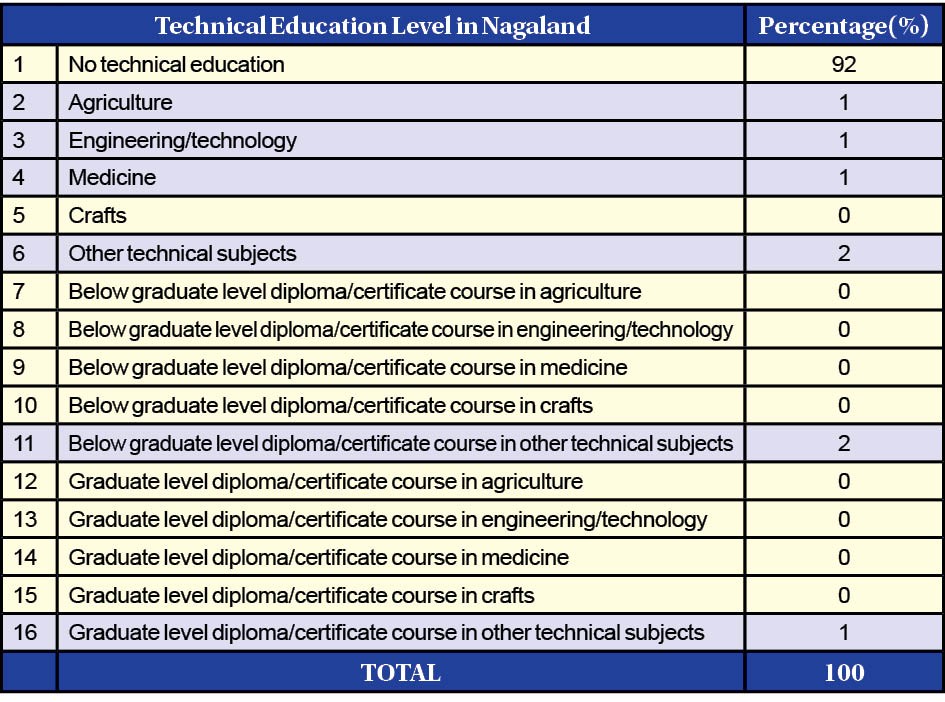
A striking 92% of residents reported having no technical education at all, underscoring the near-total absence of structured skill formation.
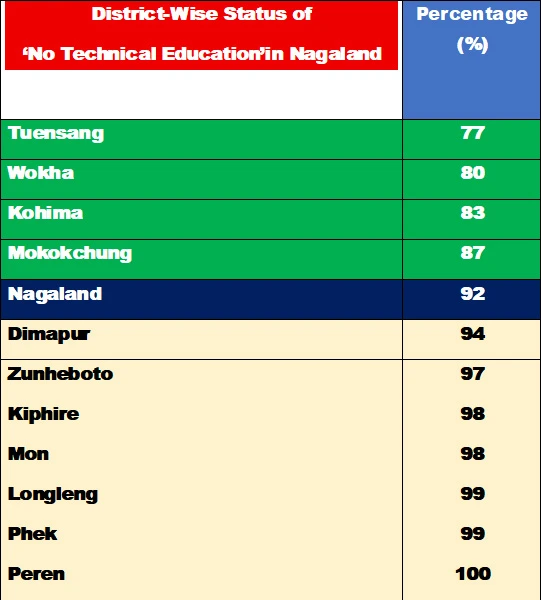
Concerningly, no respondent in Peren district reported receiving any technical education, while Longleng and Phek recorded the highest proportions without technical education at 99% each. Tuensang reported the lowest share of residents without technical education at 77%, followed by Kohima (83%) and Mokokchung (87%), while the remaining districts ranged between 92% and 98%.
Meanwhile, only 1% each reported technical education in agriculture, engineering/technology, or medicine, while 2% were trained in other technical subjects. Participation in craft-based technical education was nil.
Further, for both graduate-level and below-graduate-level diploma or certificate courses across various technical fields- including agriculture, in which a large share of the population is engaged, the survey recorded an almost complete absence of training. Only 1% reported holding a graduate-level diploma or certificate in other technical subjects, pointing to a workforce largely without formal technical qualifications.
The lack of vocational and technical training extends beyond entry into employment. The survey noted that none of the residents received formal vocational or technical training on the job.
Among those who were vocationally or technically trained, 6% reported receiving formal training prior to employment, while 1% each cited self-learning and hereditary learning. The categories of learning on the job and other modes of training both recorded 0%.
Status of formal vocational technical training in Nagaland | Percentage (%) | |
1 | Aerospace and aviation | 0 |
2 | Agriculture and food processing | 5 |
3 | Gems and jewellery, leather, rubber, furniture and fittings, printing | 4 |
4 | Handicraft, creative arts and cottage industry | 2 |
5 | Automotive | 4 |
6 | Beauty and wellness | 3 |
7 | Chemical engineering and hydrocarbons | 0 |
8 | Civil engineering (construction, plumbing and painting) | 3 |
9 | Electrical and electronics | 5 |
10 | Healthcare and nutrition | 9 |
11 | Hospitality and tourism | 4 |
12 | Iron and steel fabrication | 2 |
13 | Information technology | 12 |
14 | Logistics | 1 |
15 | Mechanical engineering | 1 |
16 | Media and entertainment | 4 |
17 | Office and business-related work | 1 |
18 | Security | 0 |
19 | Telecom | 0 |
20 | Textiles, handlooms and apparels | 5 |
21 | Childcare and pre-school | 6 |
22 | Others | 29 |
| Total | 100 |
Data Source: Survey Report on Employment, Unemployment, Skill and Migration in Nagaland 2025, Directorate of Economics and Statistics (DES), Nagaland.
Skilling limited to few sectors
A closer look at the distribution of formal vocational and technical training further highlighted the uneven nature of skilling in Nagaland even among the small proportion of residents receiving training.
The largest category was ‘Others’ (29%), a broad grouping that limits clarity on specific skill pathways. Among identifiable sectors, Information Technology (12%) emerged as the most prominent field of formal vocational training, followed by Healthcare and nutrition (9%) and Childcare and pre-school education (6%).
Traditional and semi-skilled sectors such as agriculture and food processing (5%), electrical and electronics (5%), and textiles, handlooms and apparels (5%) accounted for modest shares. Hospitality and tourism (4%) and automotive (4%) also featured marginally.
In contrast, several core technical and strategic sectors including aerospace and aviation, chemical engineering and hydrocarbons, security, and telecom recorded zero participation. Training in mechanical engineering (1%), logistics (1%), and office and business-related work (1%) remained negligible.
Govt funding inadequate
Survey data indicated that government support accounts for a minority of formal vocational and technical training in Nagaland, with most trainees relying on their own resources.
According to the survey, 61% of respondents who underwent vocational or technical training financed it through own funds, while only 33% received government funding. The remaining 6% reported financing their training through other sources.
Data on training duration showed that the largest proportion of respondents (27%) undertook training for six to twelve months, while those who trained for 18 to 24 months accounted for the smallest share (6%).
In terms of training mode, 45% of respondents underwent training as full-time trainees, followed closely by part-time trainees (43%). A further 12% reported receiving formal vocational or technical training on the job.
Overall, the survey highlighted that improvements in general education have not been accompanied by a corresponding expansion in technical and vocational training in Nagaland.
This is Part II of a series on the findings of the 'Survey Report on Employment, Unemployment, Skill and Migration in Nagaland 2025.'