

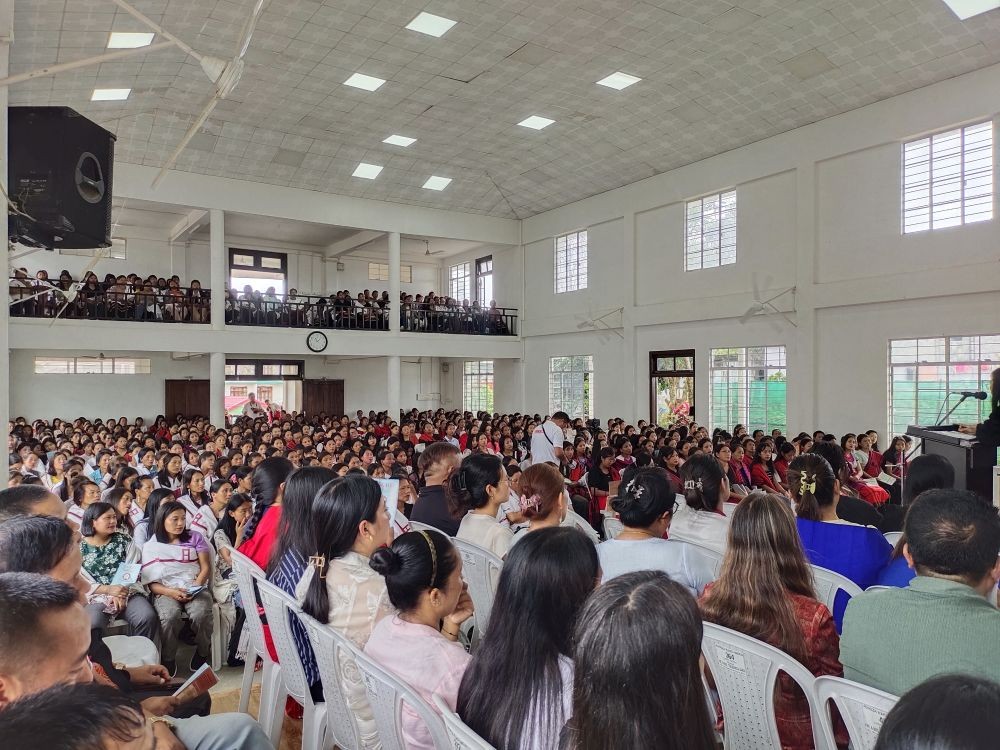
Participants attending the sensitisation programme on ‘Protect Children and Empower Women’ organised by ENWO Mokokchung Unit at Aongza Ki on July 11. (Morung Photo)
ENWO president urges societal action on child abuse
Morung Express News
Mokokchung | July 11
Raising concern over the treatment of students in sections of Naga households, Eastern Nagaland Women Organisation (ENWO) President Yingphe Konyak on Saturday alleged some families of exploiting children as domestic labour while denying them the education they were promised.
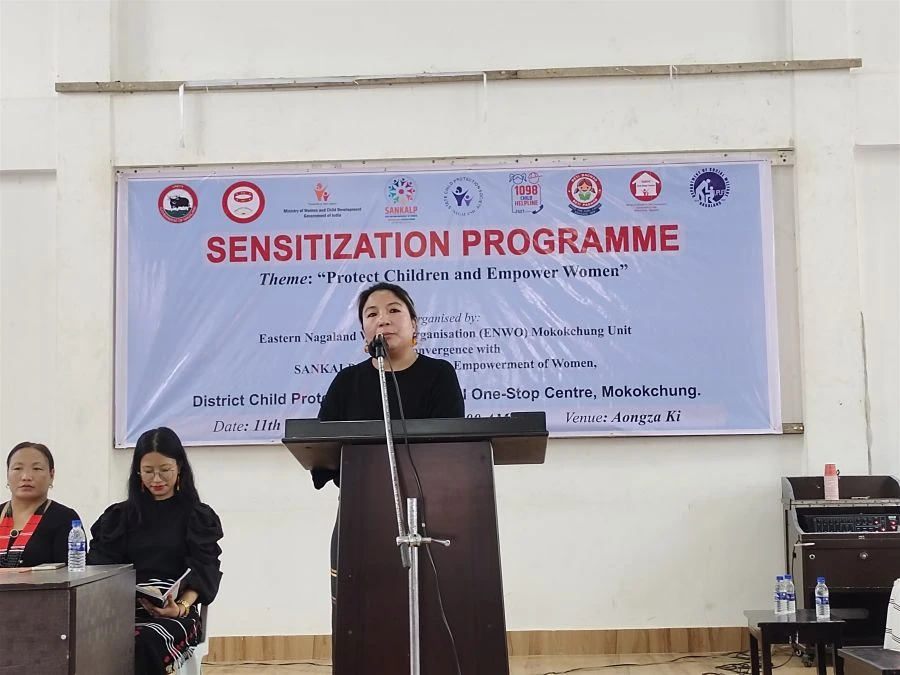
Konyak was delivering the keynote address at a sensitization programme organised by ENWO Mokokchung Unit in collaboration with SANKALP–District Hub for Empowerment of Women (DHEW), District Child Protection Unit (DCPU), and Sakhi One Stop Centre, Mokokchung. The event was held at Aongza Ki on July 11.
Addressing the programme on the theme ‘Protect Children and Empower Women,’ Konyak said that many children leave their villages with dreams of education, believing they will be cared for like family, but instead find themselves denied opportunities and subjected to exploitation.
“Children are not sent to your homes to become labourers,” she said. “They come with dreams and vision, hoping to study and become someone in society. But are you supporting those dreams, or are you depriving them of education and making them labourers?”
Noting that Mokokchung, after Kohima and Dimapur, accommodates a large number of students from Eastern Nagaland, Konyak urged families hosting children to reflect on whether they were treating them with the same care and dignity afforded to their own children.
“Children have a right to live in dignity. We elders have not been given the right to deprive them of their rights,” she asserted.
Drawing from what she described as recurring experiences across the state, Konyak said some children living away from home gradually lose contact with their families and culture while also missing out on the education they were promised.
She also pointed to unequal treatment within households. “When you give your own child warm rice but another child in your home cold rice, that is the reality of our society,” she remarked, adding that those unwilling to care for children properly should not assume responsibility for them.
Konyak maintained that protecting children cannot be left to government agencies alone and called on churches, church-run institutions, village councils and civil society organisations to become more proactive.
“When rape or child molestation happens, what is the responsibility of the church? What is the responsibility of the community?” she asked. “Only when churches, communities, civil society organisations and village councils work together can we move in the right direction.”
Expressing concern over the growing incidence of rape, child sexual abuse and other violent crimes, Konyak observed that such cases were once uncommon in Naga society. She questioned whether increasing education and technological advancement had translated into moral progress.
Konyak further urged civil society organisations to widen their focus beyond issues such as alcohol and drug abuse. “Do not limit yourselves to checking alcohol and drugs,” she said. “Talk about education. Talk about healthcare. Talk about the women who die on the way to hospitals because of inadequate facilities in Eastern Nagaland. These are also our responsibilities.”
On women’s empowerment, Konyak said gender inequality remains deeply rooted despite visible progress in urban areas. She argued that discrimination often begins within families, where girls are taught to compromise while boys are encouraged to lead.
“We teach our daughters to remain silent and to compromise, while our sons receive more privileges,” she said. “If we ourselves do not respect women, society will never respect women.”
Calling on mothers to encourage their daughters to pursue education and leadership, Konyak said lasting social change must begin at home. “Respect men, but do not fear them. Stand up for your rights. We have to start from our own kitchens. Only through a collective and inclusive society can we truly move forward together,” she added.
The second session featured technical presentations by resource persons from various departments. District Mission Coordinator, DHEW Mokokchung, Moamenla Longkumer, highlighted women-centric government schemes and welfare programmes, while Centre Administrator of Sakhi One Stop Centre, Mokokchung, Wangshinaro Yaden, spoke on gender-based violence and child marriage, focusing on legal provisions, support services and the importance of reporting abuse.
District Supervisor, DCPU–Child Helpline, Imnatula, also made a presentation on child protection and child labour, outlining children’s rights, the harmful effects of child labour, and the role of communities in preventing abuse and exploitation.
According to the organisers, the programme was attended by over 700 participants.
