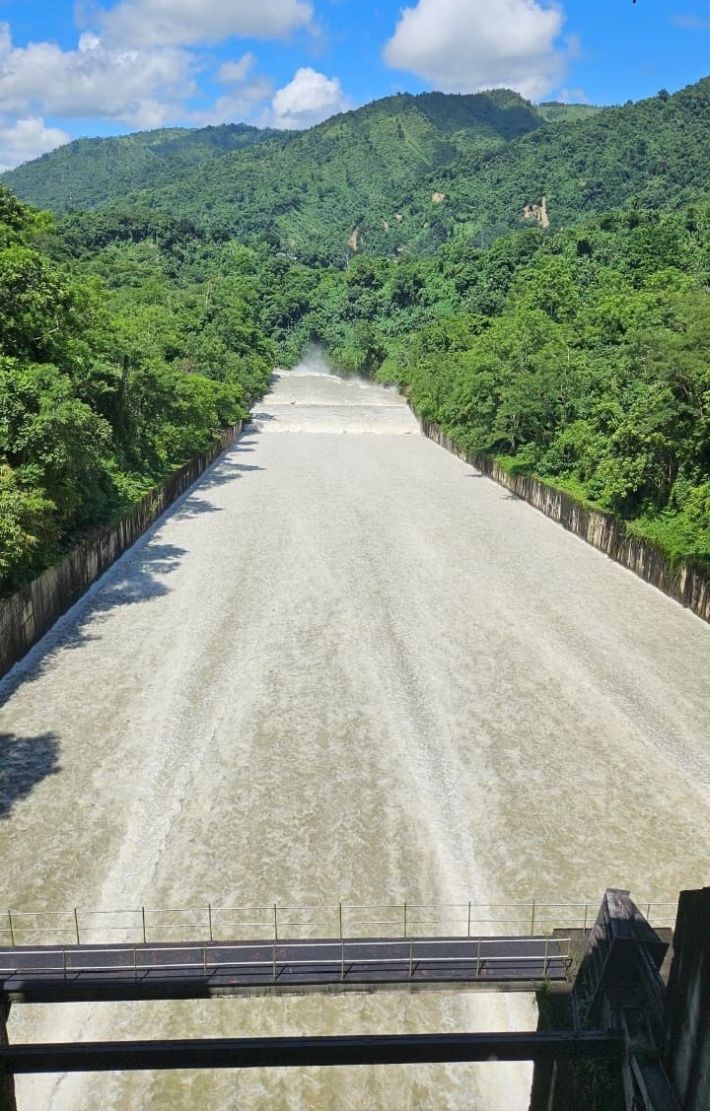
Phased discharge of excess water from the Doyang Reservoir began August 5 after heavy rains, with precautionary advisories issued for downstream Assam.
Meribeni T Kikon
Wokha | August 6
The North Eastern Electric Power Corporation Limited (NEEPCO) on Thursday said the controlled release of excess water from the Doyang Reservoir was carried out in phases following continuous rainfall that led to a rise in the water level.
Responding to queries from The Morung Express, NEEPCO official detailed the sequence of spillway gate operations, stating that the releases were undertaken only after continuous rainfall caused a rapid rise in reservoir levels and were regulated in phases to ensure dam and downstream safety.
The clarification came after NEEPCO raised all four spillway gates on August 5 to discharge excess water, prompting precautionary advisories for downstream areas in Assam.
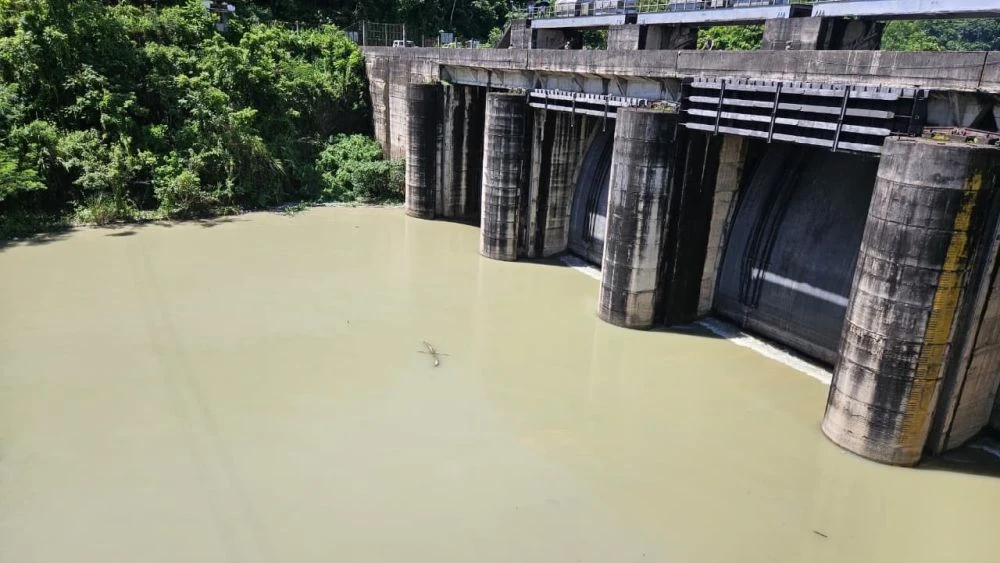
Providing details on the spillway operations, Senkathung Patton, Head of Power Station, Doyang Hydro Power Station, said the Doyang Hydro Electric Project, located on the Doyang River in Wokha district of Nagaland, is equipped with a gated ogee spillway comprising four radial gates measuring 12 metres by 12 metres each. Operation of the spillway gates is carried out strictly in accordance with the approved Standard Operating Procedure (SOP), taking into account “reservoir safety, downstream safety, prevailing hydrological conditions and weather forecasts issued by the competent authorities.”
Reservoir monitoring had been underway since the onset of the monsoon, with Reservoir Water Level (RWL) data being shared from July 2 through the “NEEPCO Flood Alert GLGT” WhatsApp group constituted by the district administration, Golaghat, Assam. The group includes officials from NEEPCO, District Administration Golaghat, DDMA Golaghat, DDMA Wokha, SDO (Ralan), Central Water Commission (CWC), and other concerned authorities.
It was reported that throughout the monsoon period, reservoir level data, spillway gate status, and discharge details were continuously shared with all stakeholders. During periods of rapidly rising reservoir level, updates were disseminated on an hourly basis and subsequently on half-hourly intervals whenever required.
The reservoir witnessed a rise in inflow between July 20 and July 22 due to continuous rainfall over the Doyang catchment. The reservoir level increased from EL 315.60 metres on July 20 to EL 319.50 metres by the morning of July 22. During this period, all three generating units of the powerhouse remained operational, while the reservoir received an estimated cumulative inflow of about 68.02 million cubic metres (MCM) within 48 hours, including powerhouse discharge, the official said.
Considering the unprecedented rate of inflow and the likelihood of the reservoir approaching the Full Reservoir Level (FRL) of EL 324.00 metres, the Project Authority issued an advisory to all the concerned authorities on July 22 that “spillway radial gates would be operated in a phased and controlled manner once the reservoir reached EL 321.00 metres, well before attaining the FRL.” Simultaneously, the Deputy Commissioner-cum-Chairman of the District Disaster Management Authority (DDMA), Golaghat, issued preparedness advisories to subordinate administrative authorities.
The first controlled spillway operation commenced on July 23 after the reservoir level reached EL 321.40 metres, following which “all stakeholders were informed through the Flood Alert Group.”
Gate Nos. 2 and 3 were initially opened by 0.50 metre, resulting in a spillway discharge of approximately 29 cumecs. As inflows continued to increase, Gate No. 4 was opened later in the afternoon, followed by Gate No. 1 during the night. By the morning of July 24, all four spillway gates had been opened to one metre each, increasing the spillway discharge to around 178 cumecs. Later that day, Gates 2 and 3 were further raised to 1.25 metres, taking the spillway discharge to approximately 209 cumecs, while dissemination of reservoir level data was intensified to half-hourly intervals.
As inflows gradually receded, gate openings were reduced in phases from July 25 onwards. By July 27, only Gate No. 1 remained open, reducing spillway discharge to around 38 cumecs.
However, fresh forecasts issued by the India Meteorological Department (IMD) and the Nagaland State Disaster Management Authority (NSDMA), predicting “moderate to heavy rainfall over the catchment,” necessitated further preventive regulation of the reservoir. Gate operations were accordingly adjusted between July 28 and August 4 “for maintaining the reservoir level within the prescribed rule curve.”
Another significant rise in inflow was recorded on August 5 following widespread rainfall across the Doyang catchment, including 137.4 mm recorded at the Kohima Automatic Weather Station during the previous 24 hours. Reservoir levels rose steadily during the early hours, prompting Gates 2, 3 and 4 to be raised to one metre at 6 am. By 1 pm, all four spillway gates had been raised to 1.25 metres each, increasing spillway discharge to approximately 207 cumecs.
On public safety measures, the Project Authority said “NEEPCO has established a comprehensive Early Warning System for Doyang Reservoir” comprising five Automatic Weather Stations with satellite and GSM/GPRS communication, one real-time upstream discharge measuring instrument, 60 manual warning sirens handed over to the Golaghat district administration in Assam, and seven electric warning sirens installed in Wokha district.
Advance information on reservoir levels, gate operations and downstream releases was regularly shared with the district administrations, disaster management authorities of Nagaland and Assam, the Central Water Commission and other downstream stakeholders throughout the spillway operation period. Warning sirens were also activated before every regulated spillway release to alert downstream communities.
The Project Authority reiterated that the spillway operation during the monsoon season of 2026 has been undertaken strictly in accordance with the approved SOP, with continuous assessment of hydrological conditions, IMD weather forecasts, NSDMA advisories, reservoir rule curve, and dam safety requirements. “All gate operations were executed in a phased, controlled, and well-coordinated manner, while ensuring continuous dissemination of information to all concerned authorities and downstream communities well in advance,” he added.