

Officials along with the farmers during a training programme on “Integrated Crop Management for Sustainable Sesame Production in Nagaland” at Dhansiripar on August 24.
Dimapur, August 24 (MExN): The All India Coordinated Research Project (AICRP) on Sesame, School of Agricultural Sciences (SAS), Nagaland University, Medziphema Campus, in collaboration with the Agricultural Technology Management Agency (ATMA), Chumukedima, organised a one-day training programme on “Integrated Crop Management for Sustainable Sesame Production in Nagaland” at Dhansiripar on August 24.
The programme, chaired by Livika K. Zhimomi, Block Technology Manager, Dhansiripar Block, was attended by farmers from the area.
Dr Rokozeno, Scientist (Entomology), AICRP on Kharif Pulses, SAS, Nagaland University, spoke on major insect pests affecting sesame and their management, with emphasis on organic and eco-friendly pest management practices. The use of yellow sticky traps and pheromone traps was also demonstrated to the farmers.
Dr Debika Nongmaithem, Assistant Professor, Department of Agronomy, SAS, Nagaland University and Project In-charge, AICRP on Sesame, highlighted the importance of adopting suitable high-yielding sesame varieties to improve productivity in the state.
She noted that farmers often rely on locally produced seed, which may have comparatively lower yield potential and longer crop duration. She also stressed the importance of soil fertility management for achieving higher sesame yields and encouraged farmers to use organic inputs that can be prepared at the farm level.
Nongmaithem said further training programmes on compost preparation and organic soil fertility management would be organised for farmers interested in sustainable and organic sesame production.
The training also covered key agronomic practices for enhancing sesame productivity, including line sowing to maintain optimum plant population, proper water management and the role of sulphur in improving oil production.
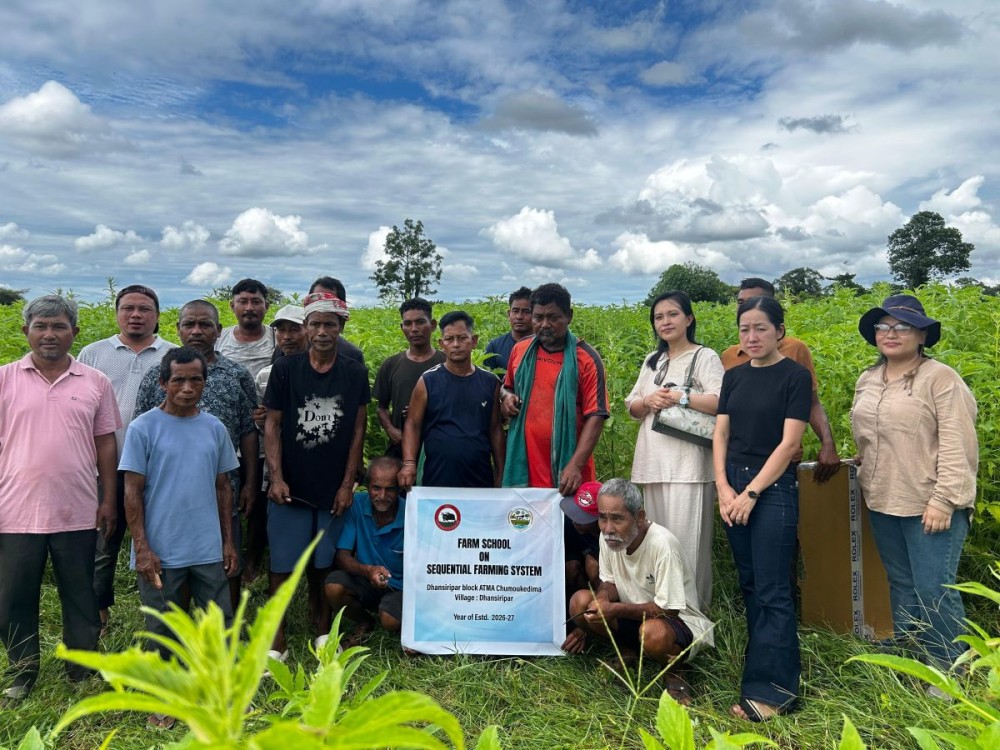
Following the training, participants visited a farmer's field where sesame was cultivated over approximately three bighas. During the field visit, a Farm School on “Sequential Farming System” was inaugurated, with sesame included as one of the important components of the farming system.
The programme was assisted by Florence, Assistant Technology Manager, and Viketuozo Punyu. It concluded with the distribution of agricultural inputs to 24 participating farmers.

