

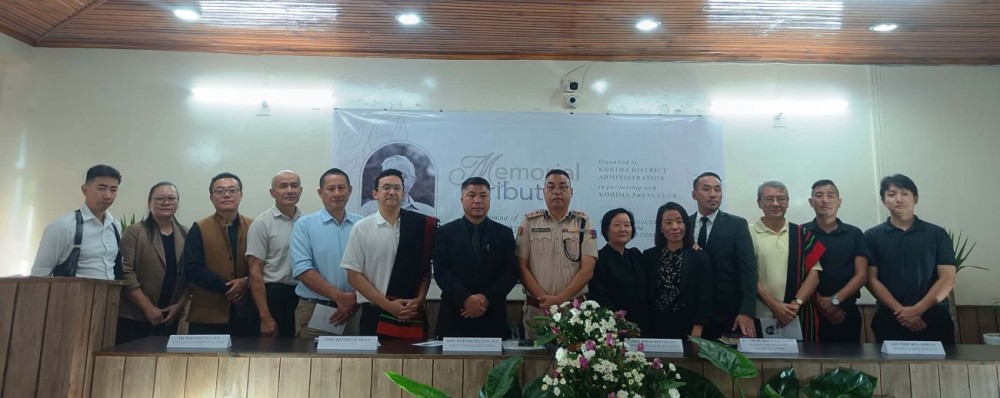
Deputy Commissioner, Kohima, Superintendent of Police, Kohima, Officials of Kohima Press Club, and other dignitaries seen with Family of Niketu Iralu during the Memorial Tribute at DC’s Conference Hall Kohima on August 27.
Morung Express News
Kohima | August 27
Honouring a distinguished son of the soil whose lifelong devotion to peace, truth and reconciliation remains an enduring beacon of light for future generations, the Kohima District Administration in partnership with Kohima Press Club (KPC) organised a Memorial Tribute for Niketu Iralu on August 27 at DC’s Conference Hall Kohima.
In his tribute message, B Henok Buchem, NCS, Deputy Commissioner, Kohima described him as a ‘true son of the soil’, a respected scholar, writer and thoughtful voice of Nagaland who dedicated his life to peace, reconciliation, dialogue and the wellbeing of the people.
He said that his commitment to truth, peace and understanding has left an enduring legacy that will continue to inspire generations. In the contemporary era, he added that, “Uncle Niketu can truly be called ‘the conscience keeper of Naga people’“ while exuding hope that his legacy of peace, dialogue and hope would continue to guide us.
Stating that Uncle Niketu was a man of high moral integrity, deep understanding, selfless and a very peace loving man, Krodi Rhetso, IPS, Superintendent of Police, Kohima remarked that, “his life and works have enriched, influenced and inspired all those who had the privilege of knowing him.”
While also recalling his personal association with him, he further testified that “his, was a life well-lived, leaving behind a legacy of peaceful coexistence and goodwill among all sections of men, showing us the path of resolving conflicts in a peaceful manner with dialogue, negotiation, forgiveness and resolution.”
‘His powerful message of peace will continue to guide us’
Advisor to Kohima Press Club, Alice Yhoshü exuded belief that Uncle Niketu always had a ‘soft-spot’ for journalists and writers while highlighting that, “he was an avid reader himself, not forgetting his flair for writing as well.”
This, she said was evident from the way he liked to share any written material or articles that he found to be inspiring and important especially for us Nagas.
Beyond his public persona and accomplishments, she said that, “Uncle Niketu was also a passionate advocate for justice, an environmentalist, someone with profound humility.” She also emphasised that “his life reminds us that at the heart of true greatness lies the spirit of giving back and lifting others up.”
In remembering Uncle Niketu, she expressed that, “we are reminded of the enduring power of the courage to speak truth to power.”
Further sharing two truthful observations he had made--’Instead of putting each other down by criticism, we should learn to inspire and raise each other up to do what is right, needed and best for the common good. We inspire others the moment we point out precisely the places where we, not others, have been or are wrong!’
‘Our common duty is to nurture the health of the Naga tree, not fight over its fruits which will lead to its destruction’, Yhoshü thanked him for the lessons, for the beauty shared, and for his powerful message of peace that will continue to guide us.
As a journalist, Seyiekietuo Keretsu said he has had the privilege of recording many of his speeches and realisation that he also collecting pieces of a legacy while highlighting his words about forgiveness, his insistence on responsibility, his belief in truth, his warning against selfishness, his call to choose what is right over what is easy and above all, his unwavering belief that our society can still heal.
“Even when he spoke about the dangers surrounding the Naga people”, he also maintained that, “he never wanted us to live in fear, but wanted us to understand our circumstances, understand ourselves and respond with wisdom rather than panic.”
“He believed that Nagas should neither consider ourselves superior nor inferior to anyone else, but should take just pride in who we are. That balance was characteristic of him—pride without arrogance, criticism without hatred, and hope without pretending that our problems did not exist”, he further expressed.
Stating that Uncle Niketu often spoke of hope, he said, “he believed that even in darkness, individuals could choose to become a source of light.”
Rev Dr Ruokuovilie Sachü, President, Kohima Baptist Pastors’ Fellowship shared the word of God while citing John the Baptist from the Bible, whose life, he added was similar to that of Uncle Niketu’s, who spoke of the one coming after him who is greater than he is. Although Uncle Niketu is no more, he said, “we have Jesus with us.”
‘Niketu’s heart remained anchored to his homeland’
Born on July 12, 1935 at Phek, Niketu Iralu was from Khonoma Village, and was among the thirteen children born to Dr Sevilie Iralu and Vituno Iralu. His father was one of the pioneering Naga medical doctors, the 3rd amongst the Nagas while his mother was the elder sister of A. Z. Phizo.
His biography read out by Vishü Rita Krocha, President of Kohima Press Club also stated that he grew up during the tumultuous times and despite his father being a non-political figure, the family was subjected to constant suspicion and mistrust due to family relationship with Phizo. These early trials gave Niketu a deep experience of the wounds, trauma, and complex perspectives that defined the region.
She also highlighted about his journey with the Initiatives of Change (IofC) that took him across Asia, the Pacific, Europe, and North and South America, which exposed him to how diverse cultures navigate conflict and heal historical wounds.
Niketu Iralu was associated with the organization for 65 years and although his work took him to the international stage, Niketu’s heart remained anchored to his homeland. When he returned back to Nagaland, he focused on grassroots reconciliation and healing. In the year 2004, he was appointed as the chairman of a critical seven-member Naga National Reconciliation Commission to foster dialogue and understanding across deep political divides amongst Nagas.
Niketu remained a leading voice for the Forum for Naga Reconciliation (FNR) movement, and worked tirelessly to bring the Naga political groups and factions to the table to end fratricidal violence.
On his return, he also fought against drug and alcohol addiction, and served as the first director and counsellor of the Mount Gilead Home in Sechü-Zubza, a rehabilitation facility focused on restoring broken lives.
He has declined multiple accolades and awards including honorary Doctorate title but his contributions were also recognized through several honours that he received in his lifetime.
Recognizing that a society cannot heal if it is fighting internal decay, Niketu became a champion for social reform. “He was grounded in the principles of personal transformation and truth telling – the basis for broader social healing.” He continually advocated for “individuals and communities to cultivate inner integrity for lasting reform and peace. He lived by his words.”
He returned to Nagaland and settled in their lovely home called “Kerünyü Ki – House of Listening” at Sechü Zubza till he passed away on August 18 in Delhi after a brief illness.
Vishü Rita Krocha also read out a tribute poem she wrote for Uncle Niketu, titled “The Guiding Light.”
His son, Kevipulie Iralu spoke on behalf of the family, highlighting about his father’s life up close.
Other highlights of the programme included “A Tribute to Niketu Iralu” by Neithonuo Tungoe, Creative Head, Take One and short video screening, ‘A Supuo La’ by Meneno Chücha while the programme was chaired by Dr. Riku Khutso, NCS, Extra Assistant Commissioner, Kohima Sadar. A moment of silence was also observed during the memorial and Uncle Niketu’s favourite hymn, “Search Me O God” was also sung with Neimenuo Kuotsu as Cantor, Er. Neilhoukholie Chielie as Violinist and Vimezo Iralu as the Pianist.

