Vishü Rita Krocha
Kohima | May 9
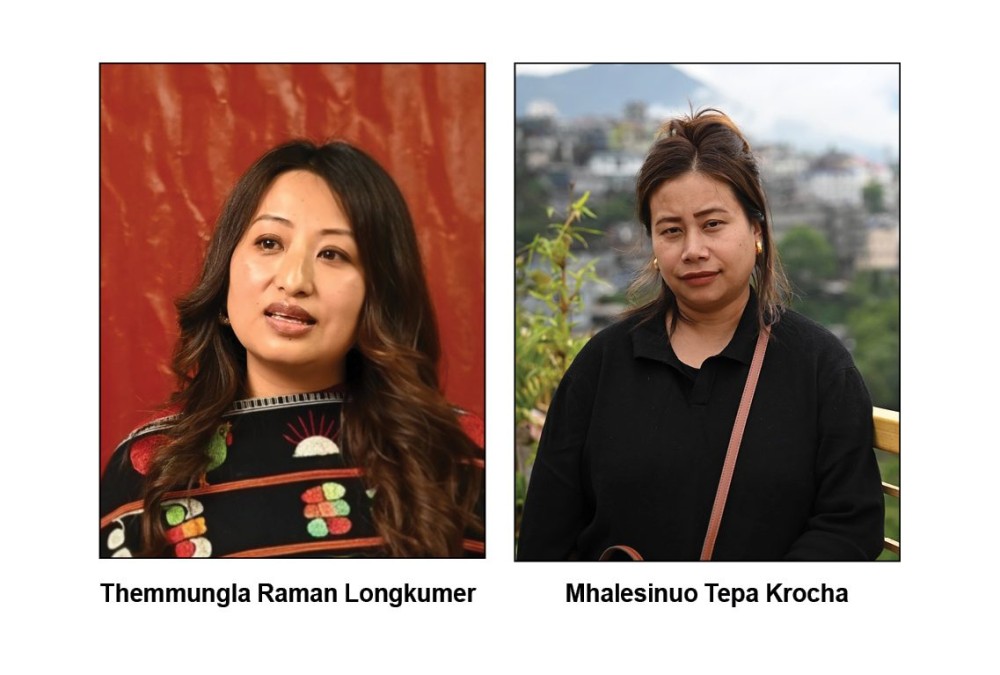
On the eve of Mother’s Day, mothers Themmungla Raman Longkumer and Mhalesinuo Tepa Krocha open up about the unseen sacrifices, silent grief and transformative love that redefine motherhood beyond its tender image.
A mother’s evolution from daughter to parent
“The way my heart can hold love for my three children, each in such different, unique ways still amazes me,” expressed Themmungla Raman Longkumer.
Motherhood, she divulged has shown her both her softness and limits, stretching her emotionally, physically and mentally even while sharing that “alongside tenderness, there are also raw edges, reactions and emotions that come from places I seriously didn’t know live within me.”
Recalling her personal journey of full term pregnancy and the quiet grief of miscarriage, she said that her body, heart and mind continue to evolve holding both creation and loss at the same time.
“But before I became a mother, I was first a daughter,” she noted while recollecting that, “growing up, I saw my mother who had all the grit, the determination and the ability to hold everything together.”
She further recalled that her mother became a mother at a young age and carried not just the responsibility of her own children but also for many others who came under her care. As a child, she expressed, “I saw what she accomplished and I didn’t always see what she had to do without.”
Now, as a mother herself, she acknowledged that, “I understand how motherhood often carries sacrifices that are never spoken out loud. Stating that as children, we don’t always remember or understand what it took but only saw the things that were being managed, she affirmed that, “now I see it differently.”
“I see the weight you carry, balancing care and responsibility, pleasure and pressure, home and work all at the same time”, she professed while also putting across that, “it has taught me that motherhood is not just about holding a family together, but it is also about building something for them to stand on.”
‘Mothers are invisible pillars of society’
Mhalesinuo Tepa Krocha, a young mother of two daughters and a son confessed that, “for a long time, I thought I understood what a mother’s love was” while relating that she grew up feeling it, receiving it, and observing it.
“But I’ve learned that there is a vast difference between being the recipient of that love and being the source of it,” she emphasised while elucidating that, “one truly begins to understand the depth of a mother’s heart only after becoming a mother themselves.”
Stating that she now looks back at her own mother with a completely different perspective, she remembered “the “extra” concern she always had, the constant check-ins, and the protective gaze that followed me everywhere—things that, as a younger woman, I’ll admit sometimes made me feel slightly annoyed or irritated.”
“Now, as I look at my own children, I finally understand”, she said even while highlighting that, “I realize that what I once saw as “over-protectiveness” was actually a heart so full of love it had no choice but to overflow in constant care. I see now that the sacrifices she made were not burdens to her, but gifts given freely out of a love I hadn’t yet learned to measure.”
Towards this end, she also asserted, “There is a reason we often say that a mother’s love is next only to God’s love” while emphasising, “it is a love that asks for nothing in return. It is a love that is always ready to embrace, no matter the circumstances or the faults.”
Just as God is always ready and willing to forgive even the most wayward child, she further articulated that “a mother is always ready to forgive, to heal, and to accept.”
“In the eyes of a mother, there is always a path back home,” she added while acknowledging every mother by stating, “You are the invisible pillars of our society, tirelessly building foundations of compassion, resilience, and integrity. Your efforts are often the quietest, yet they resonate the loudest in the kind of people your children become.”