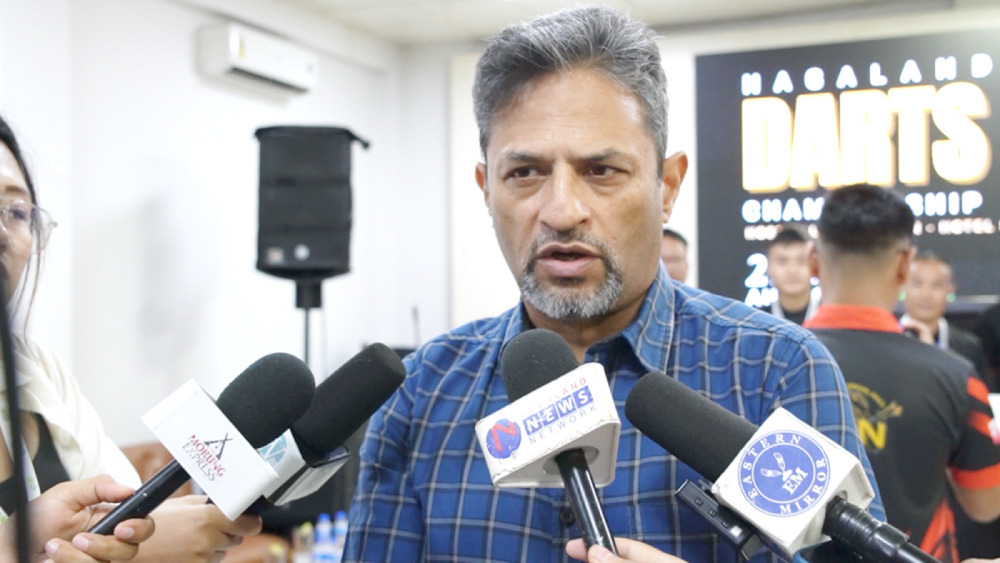
Nagaland Director General of Police (DGP) Rupin Sharma addresses the media on the sidelines of an event in Dimapur on August 22. On August 25, he announced that Nagaland Police will launch a single-window portal for citizens to report civil and criminal grievances, track complaints and access inquiry reports. (Morung File Photo)
Our Correspondent
Kohima | August 25
The Nagaland Police will launch a single-window portal to allow citizens to report all grievances, whether civil or criminal and track the status of their complaints and access inquiry reports, Director General of Police Rupin Sharma announced on Tuesday.
Addressing a state-level convergence meeting on violence against women and children, organised by the Department of Social Welfare in collaboration with the Nagaland Police and Nagaland State Legal Services Authority (NSLSA), Sharma said the portal would go live within the next 10 to 12 days.
The proposed system will allow people to submit complaints to the police regardless of whether the matter is ultimately found to be civil or criminal, Sharma said adding, “Your complaints will not go unanswered.”
Under the new system, every complaint received will be assigned by the officer-in-charge of the concerned police station to an investigating officer for a preliminary inquiry. The officer will determine whether the matter involves a cognisable offence, a non-cognisable offence, or a purely civil dispute.
If a cognisable offence is established, the police station will register an FIR. In non-cognisable cases, complainants may be advised to approach a magistrate, while purely civil matters will remain outside police jurisdiction, Sharma explained.
Complainants will be able to track the progress of their complaints electronically and, as provided under the new criminal laws, download a copy of the inquiry conducted by the police. Senior officers from the station level up to the DGP, will also have access to monitor the status of complaints in real time.
Sharma emphasised that the system could be particularly useful in cases involving domestic violence, child abuse, stalking, and harassment. “Repeated complaints could help police identify patterns of behaviour and intervene before they escalate into more serious offences,” he said.
He further noted that complainants would be able to know whether an FIR had been registered and, if not, the reason for the same.
Highlighting the “Role of Police in implementing Women & Child Protection Services,” Sharma stressed on the need to have adequate mechanisms in place to address violence against women and children. There are areas where intervention is required by various government agencies, he noted while stressing on the need to be sensitive, empathetic and maintain a proper coordination with each other to handle things in a better manner.
Asking the stakeholders to be there for a purpose, he said that the role of the NGOs, civil society and the public is huge and it cannot be denied. “We do not want to deny your space of having a role in the society,” he said and asked the NGOs and civil societies not do anything which puts them in conflict with law. “Do not take law into your own hands,” he said. “When you are trying to intervene in a dispute or something, please look at whether by doing an intervention you are yourself committing a crime or not, you are rubbing yourself on the wrong side of law,” he said.
On the need to look at Money Lenders Act in Nagaland, the DGP said it is not just as a control on illegal or unauthorised money lending but as a pure case of extortion taking place. The Supreme Court has barred the police from intervening in civil disputes, he reminded. “We issued a proper full scale instruction to police officers at the police station level in Nagaland, and Nagaland is probably one of the first states in the country to do it,” he said.
With inputs from PTI report