(Photo source: X/@M_S_Billingslea)
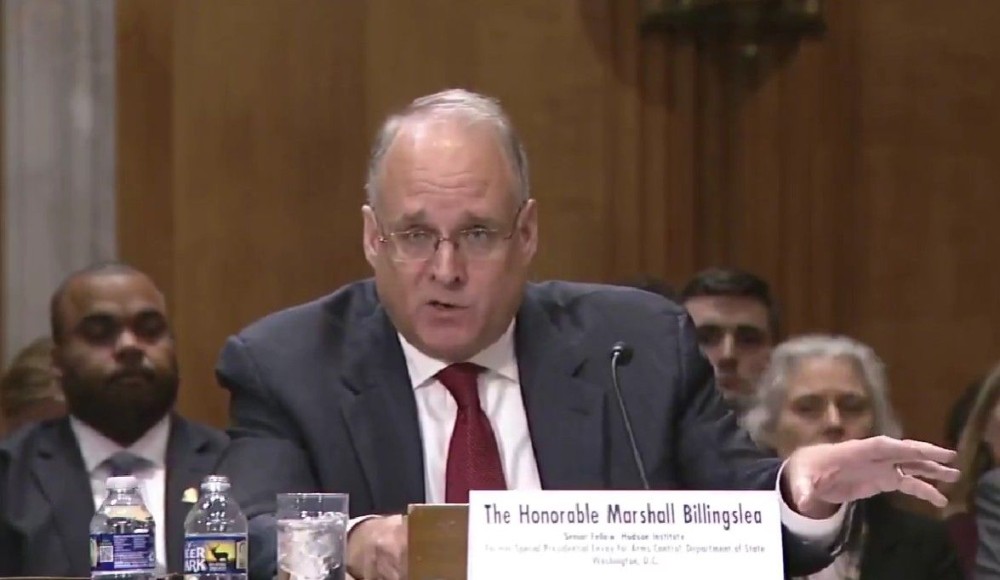
Washington, December 11 (IANS) Top American Senators heard stark warnings about China's accelerating nuclear expansion and its move toward AI-enabled command systems, with witnesses telling lawmakers that Beijing is proceeding at a "breathtaking pace" and could fundamentally shift the strategic balance across the Indo-Pacific.
The testimony carries significant implications for Asian security, including India, as China builds capabilities that extend far beyond regional boundaries.
Marshall Billingslea, the former Special Presidential Envoy for Arms Control, told the Senate Foreign Relations Committee on Wednesday (local time) that China is now "on pace to deploy as many operational nuclear weapons, strategic nuclear weapons as the United States by 2035, if not sooner."
"They're going faster than we previously briefed… It is alarming," he added.
Billingslea warned that Beijing's breakout is not limited to long-range systems. "China has ensured that virtually all of its missile systems, both intermediate range ballistic and cruise missiles, are dual capable," he said, noting that the People's Liberation Army has "built thousands of these systems." When asked whether China sought parity or dominance, he replied: "At a minimum, they're pursuing parity. I personally believe that they intend to surpass us."
Lawmakers pressed witnesses on the emerging link between artificial intelligence and nuclear escalation risks. Senator Dave McCormick described AI's expanding role in "enhanced intelligence, surveillance and reconnaissance… threat detection and decision support processing," warning that it could have "positive and I assume negative ramifications for global stability."
Billingslea cautioned that China's shift toward high-speed launch decisions was especially dangerous in an AI-driven environment. "China is moving to a launch-on-warning posture and the potential for miscalculation with that posture… really does create sort of a hair trigger kind of environment," he said. If AI is "not controlled fully by humans, (it) could cause real problems."
Rose Gottemoeller, former Undersecretary of State for Arms Control, added that Washington and Beijing had taken only a tentative first step. She noted that President Biden and President Xi Jinping had agreed that "there should always be a person in the loop… for nuclear command and control decision making," a formulation she called "an important step forward." She said future diplomacy must "flesh out exactly what that means because technically it is a difficult matter to sort out."
Both witnesses warned that China has resisted sustained nuclear talks even as it modernises at unprecedented speed. Gottemoeller said the Chinese have been "very active in multilateral settings… but not on a bilateral basis." Still, she pointed to signs of movement, noting Xi Jinping's agreement to meet President Trump twice in 2026, saying, "This presents some opportunities now for engaging them, and the door seems to be beginning to crack open."
For India and Indo-Pacific states, senators said the implications are far-reaching. China's nuclear and missile trajectory -- combined with AI integration -- places new pressure on regional deterrence frameworks, crisis-management mechanisms, and missile-defence planning.
While India was not mentioned in testimony, experts say any dramatic shift in Chinese nuclear posture inevitably affects the strategic environment stretching from the Himalayas to the Western Pacific, especially as Beijing develops capabilities intended for both continental and maritime theatres.
The Committee also examined how Beijing's modernisation interacts with its partnerships with Russia and North Korea. Billingslea described Russia–China nuclear cooperation as "worrisome", adding that Moscow is helping Beijing "obtain the fissile material necessary for its buildup." Senators warned that such networks strengthen Chinese capabilities in ways that will ripple across Asia.
Notably, China already possesses the world's largest inventory of ground-launched ballistic and cruise missiles, many with ranges relevant to South Asia and the Indian Ocean. Its rapid expansion of missile silos, testing of hypersonic glide vehicles, and reported development of fractional orbital systems place it at the centre of a new strategic competition shaping Indo-Pacific security debates.
The United States has repeatedly stated that China's refusal to engage substantively on nuclear transparency contradicts its obligations under the Nuclear Non-Proliferation Treaty, which requires nuclear-weapon states to "pursue negotiations in good faith."
For India, which follows a declared no-first-use posture outside the NPT framework, China's trajectory -- combined with Beijing's advances in space, cyber, and AI warfare -- underscores why the Indo-Pacific is at the heart of the emerging global nuclear order.