A 24-year wait and a blip? How Nagaland’s new industrial policy quietly ‘rolled out’
Over a year after replacing the 2000 industrial policy, Nagaland’s NTIIP 2025 supposedly remained in force with little visible public communication until its detailed rulebook quietly surfaced online this month
Moa Jamir
Dimapur | August 26
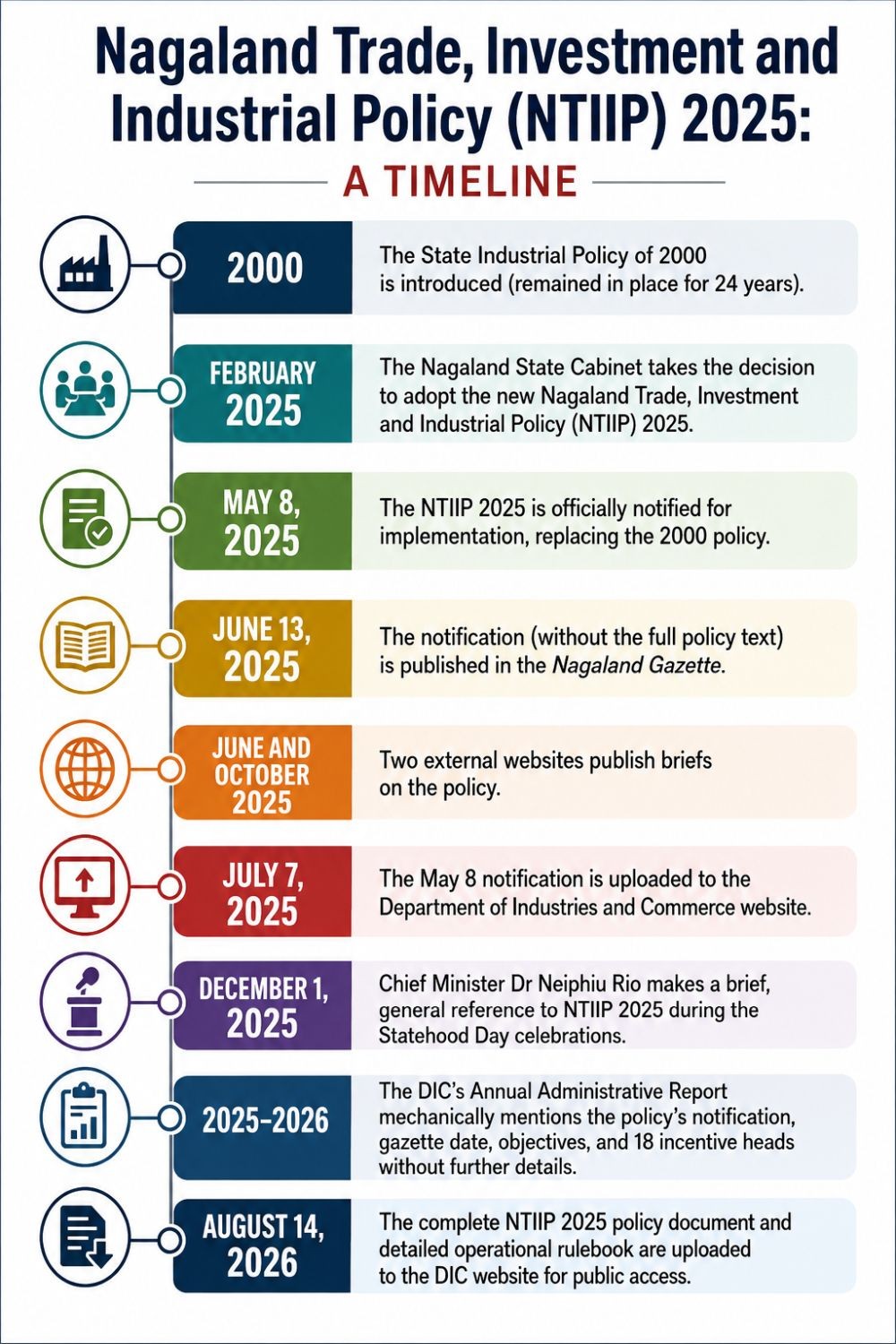
After a 24-year wait for a new industrial policy, the Nagaland Trade, Investment and Industrial Policy (NTIIP), 2025 was notified on May 8 last year, setting out a new framework to promote investment, entrepreneurship, industrial growth and employment.
The policy itself was formulated to replace the State Industrial Policy of 2000, acknowledging that the industrial sector in Nagaland had continued to make a low contribution to the economy and that growth in trade and industry had failed to match Nagaland's potential.
Yet the rollout of what was arguably one of the State's most significant economic policy interventions in more than two decades has had been remarkably quiet.
A mechanical entry, little more
As per the May 8, 2025 notification, the NTIIP was notified for implementation based on decision taken in the Cabinet meeting held on February 2025.
The Department of Industries and Commerce’s (DIC) Annual Administrative Report for 2025-26 briefly mentioned the policy under the generic heading “State Industrial Policy,” while ambiguously noting that the NTIIP 2025 “has been notified on 8th May 2025 for implementation in the State and has been published in the Nagaland Gazette on 13th June 2025.”
However, the entry is largely mechanical, recording the notification and Gazette publication, listing the broad objectives and reproducing the 18 incentive heads from the policy booklet.
It sheds little light on the policy’s actual rollout, including implementation guidelines, access to incentives, applications status and other details.
Moreover, the June 13, 2025 Nagaland Gazette also published only the notification, not the full policy. The May 8 notification was uploaded the Department's website on July 7, 2025.
Only a year later, the NTIIP 2025 policy document surfaced on the DIC website on August 14, 2026 enabling wider public access.
Public references limited
A review of publicly available information also found little substantive communication in the form of Departmental press releases, policy updates or other public statements explaining or updating on the NTIIP 2025 as well as the implementation during the supposedly in force period.
The few public references were similarly limited.
During the Statehood Day celebrations in December 2025, Chief Minister Neiphiu Rio briefly said the policy aimed to strengthen the industrial ecosystem, encourage entrepreneurship, generate employment and boost the economy.
However, the reference was not specific, but formed part of a broader review of government activities.
No mention was made by either the Chief Minister or the Governor during the State's last budget session.
Technically, the policy was neither hidden nor secret, having been formally notified and gazetted; yet mere official record cannot substitute for meaningful public communication.
Beyond official platforms, only limited external references to the policy notification could be traced.
An October 2025 India Brand Equity Foundation (IBEF) infographic listed NTIIP 2025 among Nagaland's key policies, while TeamLease RegTech published an update based on the May 8, notification. Neither, however, appeared to be based on the full policy document or its detailed operational framework.
The unanswered question
For a policy intended to reshape Nagaland's industrial and investment landscape, the absence of visible and sustained public communication is striking, to say the least.
More so because the detailed framework now available online shows that the policy involves far more than a broad declaration of intent.
Among others, the NTIIP 2025 sets out the broad vision and a wide range of proposed assistance as well as operational framework such as eligibility criteria, registration, documents requirement, and verification and so on.
It also provides for a broad package of incentives, including capital investment support, tax reimbursement, assistance for skilling and research, subsidy, and special provisions etc.
However, with the policy supposedly already in operation, questions remain over how prospective entrepreneurs and investors were expected to navigate its detailed procedures before the framework was made publicly available online.
The Morung Express has sent a set of queries to the DIC concerning NTIIP 2025. The Department's response will be updated upon receipt.