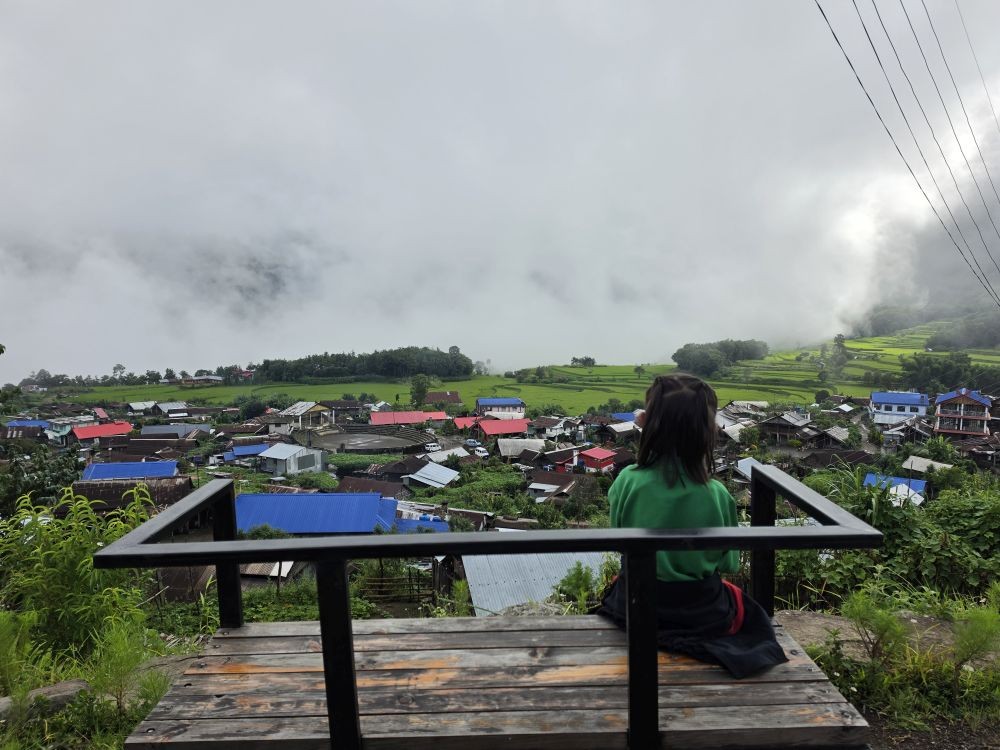
A school girl enjoys the view of the lush green fields in Zhavame village under Phek district.
Vishü Rita Krocha
Kohima | October 2
At a Government Primary School (GPS) in Kohima, students aged between 7-14 and mostly hailing from the eastern part of Nagaland and Myanmar across the border are enrolled in classes 1-5- a clear indication that most of these children are kept as domestic help in different homes.
“These children bear no signs of physical abuse, but there are also unspoken burdens that they carry with them to school. For instance, they are clearly upset when there is a half holiday,” a Government Primary Teacher who did not wish to be named, related to this writer. They would rather be in school than go home as that would mean more household chores, she highlighted.
“One thing that is quite apparent is that domestic helpers are studying in government schools,” Fr Innocent Panmei, SDB, Principal of Don Bosco Higher Secondary School, Kohima pointed out.
Observing while there are few households that take them in as family members and share the same table, he expressed pain at the sight of seeing some children attending government schools, dressed so shabbily, besides being treated very badly.
Even if children are taken in for the sake of education, he underlined that treating them as dignified human beings should remain a priority while impressing upon that, “we can at least give them dignity.”
Elaborating on this, he cited that, “they need sufficient rest time, proper sleep, deserve a Sunday break, a half-day sometimes, need medical attention when they are sick, make sure that they have a decent place to stay, proper toilets and rooms, etc.”
Domestic helpers, he further asserted must also have proper holidays and should get at least a month’s holiday in a year according to him.
In all of these actions, he exuded belief that, “we should live our Christian faith.”
“If we are able to look after them and give them a dignified life,” he affirmed that, “God’s blessings will be upon us.” As a Christian state, he also underlined that, “we have more responsibility to stand for those who cannot speak for themselves.”
Observing that most homes keep children as domestic help in exchange for their education, he said that, “once you keep them, it is our responsibility to give them a happy childhood and to make sure that once they leave our house, they have something to hold on to.”
As the head of a school and a church worker, Fr Innocent Panmei, SDB, also advocates this concern both in the educational institution and his church sermons.
Reiterating that these ‘other’ children should be well taken care of, he underscored the need for parents and elders in the family to talk to their own children, and teach them to be kind. “First of all, their children should learn to appreciate and also do household chores,” he advocated.
At the village level, he also felt that the concerned authority should have some kind of census in this regard, and further suggested that they should come up with a resolution or some kind of restriction in keeping underage workers or have some say about the issue to ensure that they are treated with respect and dignity.
Child domestic helpers: A hidden shame
In a research study titled, “Migrant and Trafficked Children in Hazardous Employment: The case of Nagaland,” published by VV Giri National Labour Institute in the year 2013, T Chubayanger interviewed a total of 302 children aged between 6 and 14, who were trafficked or migrated from their place of origin, most of whom enter the domestic sector and were either not paid or underpaid where payment exists with the employer’s contention that they are being provided with food, clothing and shelter.
The study also indicated that as per the preliminary survey exercise, Kohima and Dimapur are the destination and transit points of migrant children, a scenario which has remained unchanged since the study was last conducted.
In the villages and rural pockets, there is rarely a child from outside the village attending a government primary school, a Government Primary School Teacher attested on anonymity while highlighting that the issue of child domestic helpers being enrolled in government schools is only largely visible in places like Kohima and Dimapur.
The research study by Chubayanger also highlighted that, “the children who enter domestic employment are one of the most vulnerable groups of workers in the state as domestic work continues to be a socially neglected aspect in Nagaland for a variety of reason.” It stated that the employment relationship exists behind closed doors and remained beyond the reach of Scrutiny and awareness of the outside world and that child workers in this sector are at the mercy of terms dictated by their employers.
Of the children who had reported to be attending school in the place of destination, it was found that three-fourths are attending Government Primary Schools and only one-third are getting more than one hour of study at home. The findings of the study further suggested that there is a mismatch recorded in the age of the child and the class he/she is attending as much older children are admitted in very low class.
Another finding indicated that the employers in Nagaland consider hiring of child workers as an ‘act of charity’ as children are provided with basic needs that poverty denies them.
The Study called for community involvement including parents, guardians, children and support groups in this regard while underlining the need for attitudinal change of government and all sections of society towards child labour. “Social organisations, institutions, youth organisations, churches, etc., should join hands with the government departments and attempt should be made to make the benefits of social schemes launched by the Central and State Government to reach the families below poverty line and those who are forcing their children to work,” it advocated.
The study also called for mobilising local leaders including church heads, village chiefs, women groups and student leaders in awareness-raising for which they would require training to ensure that they understand the issue and are able to convey it sensitively, correctly and according to child protection principles.
Further underscoring the need for development and enforcement of child protection policies and legislation, the study emphasised that, “law reform is urgently needed in the area of victim protection and children’s rights” while highlighting the urgent need to articulate and forcefully implement laws and policies, which enshrine these principles.
Kohima Aor Telongjem leads the way
Kohima Aor Telongjem (KAT) also known as the Kohima Ao Union has taken the lead in preventing child labour under the leadership of T Chubayanger. During his tenures as president of the Union following his election in the year 2021, the KAT made a resolution that the Ao community living in Kohima would not be allowed to keep a child as domestic help in their homes.
The KAT also comprised six mountain ranges including Ongpangkong, Asetkong, Langpangkong Jangpetkong, Japukong, and Tsurangkong that together form the Union.
During his presidentship, he had championed the cause against child labour and even had people from his own community not liking him for doing what he believed is right.
Citing numerous instances of children being bashed up for small mistakes, he implied that when two communities decide to resolve such a case on their own, a child is denied of his/her rights to justice while the offender goes scot free.
While there have been instances when two communities resolved cases themselves, he said that in such cases, there was no option but to withdraw the case. However, during his presidentship, there have been times when an offender was put to jail because he firmly stood his ground supporting the law enforcing agencies and said, “a wrong is a wrong and punishment should be there.” The offender in this particular case was a government servant, who also faced suspension as a result.
When children are kept as domestic help on the pretext of education because their places of origin deny them this very facility, he commented that, “we think we are doing charity by keeping them but it comes down to the basic principle of us wanting to keep an extra hand.”
Otherwise, he explained, “Who would want to take the trouble of taking care of another individual and sending them to school?”
Stating that the reason we are searching for a person to stay with us is only because we want an extra hand, he further observed that, “we are saying we are keeping them well. But one simple mistake, and our human instinct tell us that they are not our blood, and for the silliest mistake, we have the tendency of shouting at them.”
While the resolution has been passed by the KAT a couple of years back, the community is still putting their heads together to resolve the already existing issue of homes that have long kept children as domestic help. However, the standing resolution that forbids it, signals hope for a better future for children.
Names have been left anonymous either at the individuals’ request or to protect identities.
Disclaimer: This report is part of the ‘Media Fellowship Initiative on Child Protection Awareness and Ethical Public Discourse’ series, supported by DKA Austria and implemented by Prodigals’ Home. The content is intended for public legal literacy and preventive awareness.