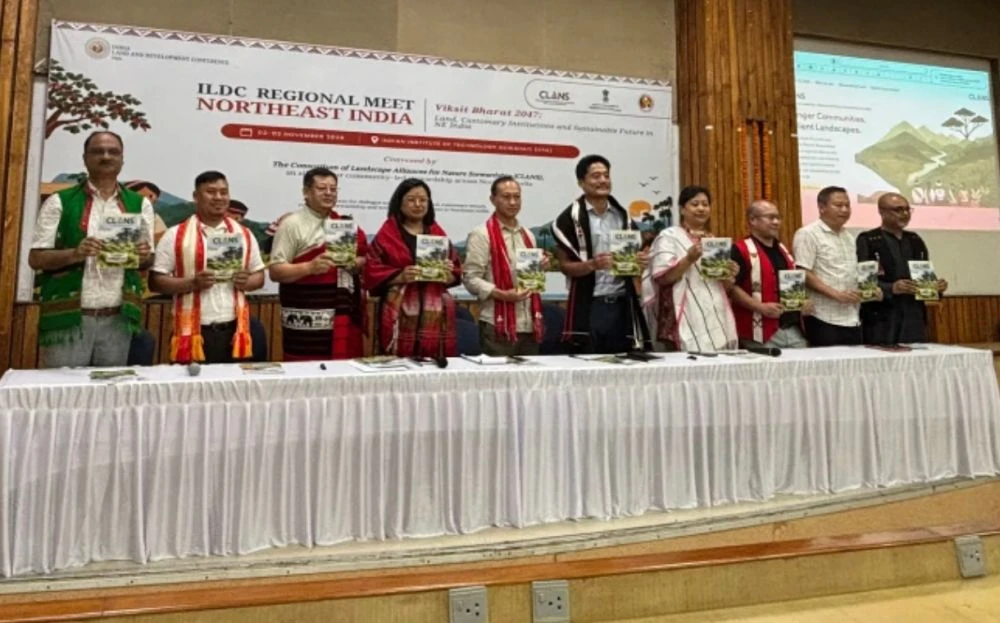
Dignitaries and delegates release a document at the launch of the Consortium of Landscape Alliances for Nature Stewardship (CLANS) during the ILDC Regional Meet on land governance and sustainable landscape stewardship, held at IIT Guwahati.
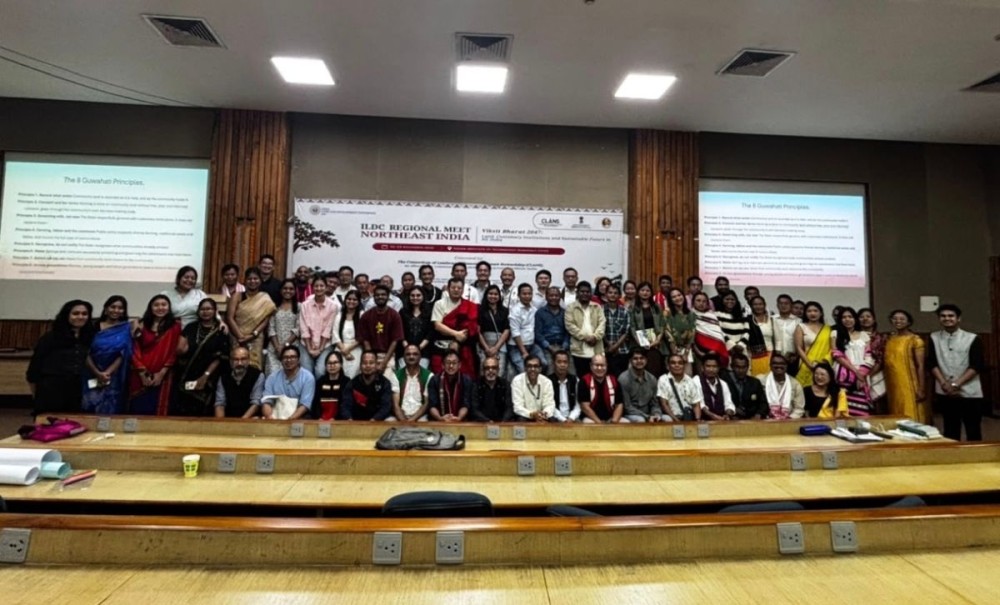
Adopts eight principles on land governance
Guwahati, November 5 (MExN): The Consortium of Landscape Alliances for Nature Stewardship (CLANS) was formally launched following a two-day regional meet at the Indian Institute of Technology (IIT) Guwahati, which adopted eight principles on customary land rights, community-led conservation and sustainable landscape governance in Northeast India.
Held on November 2 and 3 under the theme “Viksit Bharat 2047: Land, Customary Institutions and Sustainable Future in NE India,” the regional meet was organised under the aegis of the India Land and Development Conference (ILDC), endorsed by the Ministry of Development of North Eastern Region (MDoNER), and hosted by IIT Guwahati's School of Agro and Rural Technology.
The meet brought together traditional village chiefs, Rangbah Shnongs, members of Autonomous Councils, community elders, women farmers, indigenous youth, grassroots practitioners and researchers from across the northeastern hill states. Deliberations focused on customary land tenure and plural legal systems, rotational jhum cultivation, geospatial technologies and community data sovereignty, and nature markets alongside community-led monitoring and reporting mechanisms.
The conference unanimously adopted the eight Guwahati Principles, which call for upholding customary rights and constitutional protections under the Sixth Schedule and Article 371; recognising community-led conservation without diluting customary authority; and ensuring Free, Prior and Informed Consent (FPIC) through village assemblies before surveys or resource allocation.
The principles also call for recognising ancestral community lands as customary commons rather than unclassified or ownerless state property, supporting rotational farming and fallows as agroecological systems, and protecting mountain springs and recharge zones through customary arrangements.
Community control over spatial datasets, drone maps and land documentation, along with greater governance and benefit-sharing roles for women farmers and youth, also form part of the eight principles.
Building on the principles, delegates approved the drafting and finalisation of the Guwahati Declaration, which will serve as a charter for policy engagement, grassroots toolkits and landscape-level initiatives. The regional meet also featured an exhibition showcasing indigenous seeds, traditional weaving, handloom products and local agri-food items.
CLANS was established as a regional alliance bringing together customary institutions, grassroots stewardship groups and community federations to strengthen customary land tenure, indigenous knowledge and community-led ecological conservation across Northeast India. The consortium has invited community organisations, traditional village bodies, women's groups and civil society organisations to join the network. Further information is available at www.clans.life.