Nagaland gets ‘medium’ ease-of-living score; jobs at bottom
Open spaces and recreation among key weak spots
Moa Jamir
Dimapur | September 12
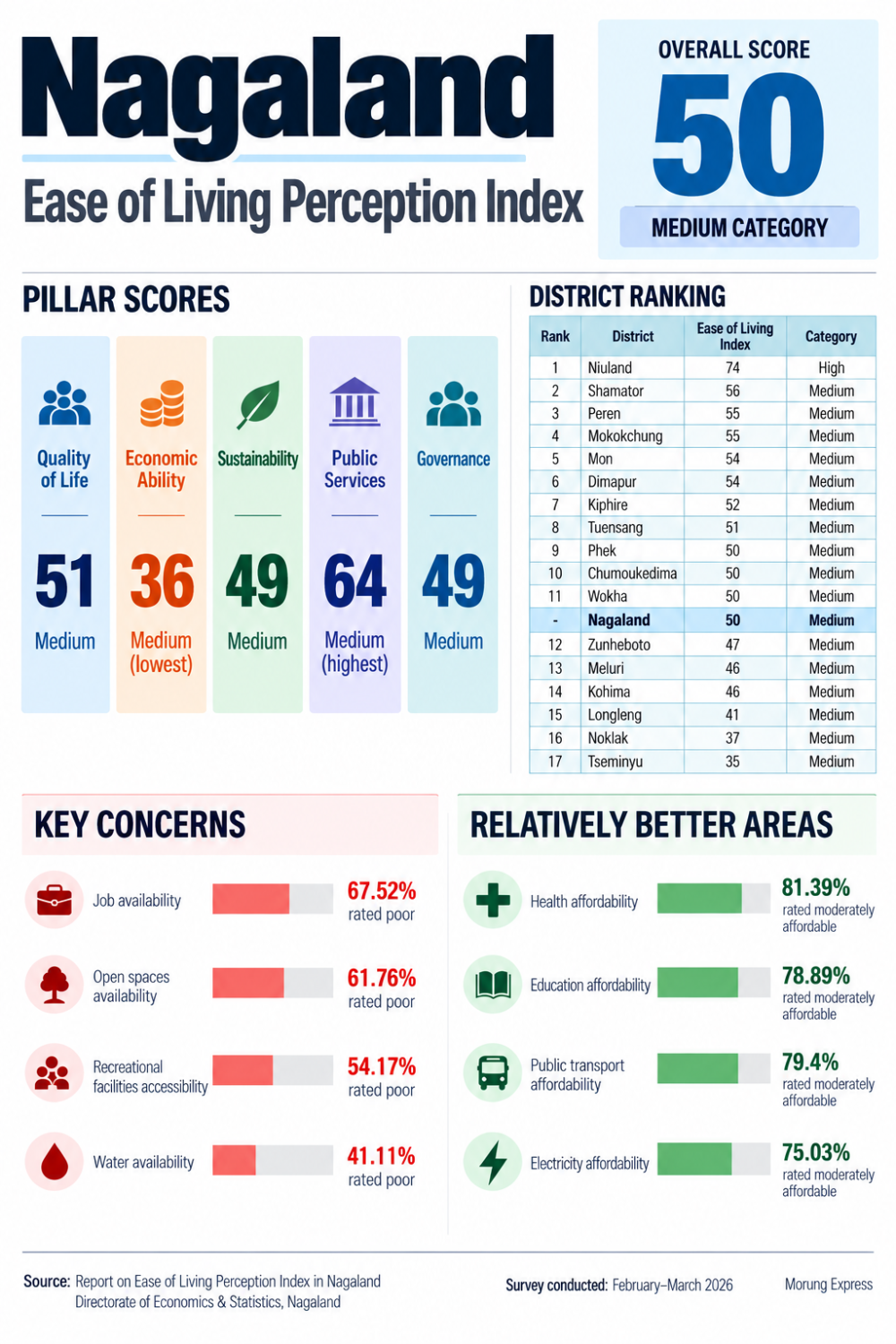
Nagaland’s Ease of Living Perception Index stands at 50, placing the State in the “medium” category, with citizens expressing relatively better perceptions of public services but significant concerns over employment, open spaces, recreation and water availability.
The findings are from the Report on Ease of Living Perception Index in Nagaland, prepared by the Directorate of Economics & Statistics, Nagaland, and recently made available in the public domain.
The survey was conducted across all 17 districts in February and March 2026. A total of 3,210 households across 214 wards in district headquarters were covered, with 9,630 respondents interviewed.
Three persons aged 15 years and above were interviewed in each selected household.
What does the index measure?
The Ease of Living Perception Index measures citizens’ perceptions across five broad pillars of livability: quality of life, economic ability, sustainability, public services and governance.
The State’s overall score of 50, however, masks considerable variation among the five pillars.
Incidentally, public services recorded the highest score at 64, followed by quality of life at 51.
Sustainability and governance both scored 49, while economic ability was the weakest pillar at 36.
Despite this wide variation, from 64 to 36, all five pillars were classified in the report’s “medium” category.
The five pillars are assessed through a range of individual variables.
Quality of life covers areas including education, health, housing, water, garbage collection, cleanliness, roads, public transport, safety, emergency response and recreation.
Economic ability looks at job opportunities, business opportunities and the presence of women in the workplace.
Sustainability includes air and noise quality, pollution-control efforts, open spaces, electricity reliability and affordability, and disaster and community response.
Public services cover birth and death registration and obtaining certificates from government offices, while governance includes community involvement, approachability of elected representatives, grievance redressal and disclosure of government reports.
The weakest links
The clearest weakness is job availability.
As many as 67.52% of respondents perceived job opportunities as poor. The indicator recorded the lowest mean score, 1.39, and was ranked No. 1 in policy priority.
The broader economic ability pillar recorded the lowest score among the five pillars at 36, although business opportunities fared better, with 50.83% of respondents rating them fair, 33.4% poor and 15.77% good. Similarly, 48.84% perceived the presence of women in the workplace as fair, 36.57% as good and 14.6% as poor.
Two other major concerns were open-space availability, perceived as poor by 61.76%, and recreational-facility accessibility, considered poor by 54.17%.
Water availability was another weak spot, with 41.11% rating it poor. Interestingly, 38.7% considered water quality good, suggesting that availability, rather than quality alone, is a significant concern.
What citizens say is relatively good
Several affordability indicators received comparatively favourable responses.
Education was considered moderately affordable by 78.89%, while health was viewed as moderately affordable by 81.39%.
Electricity affordability also scored relatively well, with 75.03% of respondents considering it moderately affordable. In contrast, supply reliability was rated fair by 50.08%, suggesting that affordability does not necessarily translate into dependable supply.
Public transport was perceived as moderately affordable by 79.4% of respondents. However, affordability did not necessarily translate into adequate service, with 60.7% rating public transport adequacy as only fair.
Education quality, safety standards, electricity supply reliability and police emergency response time were among the variables with the highest mean scores and consequently received the lowest policy-priority rankings.
‘Fair’ dominates
A striking feature of the findings is how often “fair” emerges as the dominant response.
Education quality was rated fair by 52.91%, health quality by 55.51%, road availability by 50.18%, and public transport adequacy by 60.7%.
Locality cleanliness was rated fair by 56.29%, while garbage collection, air quality and noise quality were rated fair by 44.53%, 45.97% and 48.56%, respectively. Government efforts to address pollution were rated fair by 50.4%.
Governance indicators showed much the same pattern. Community involvement by local governments was rated fair by 55.32%, while 58.86% considered elected representatives fairly approachable. Grievance redressal response time was rated fair by 61.39% at the locality level and 67.3% in offices.
In other words, the State avoids a poor assessment on many indicators, but “fair” is doing much of the work.
District ranking
There was substantial district variation in the State-level average.
Niuland ranked first with a score of 74, making it the only district in the high category.
At the bottom was Tseminyu, with a score of 35.
Eight district headquarters scored above the State average of 50: Niuland, Shamator, Peren, Mokokchung, Mon, Dimapur, Kiphire and Tuensang.
Phek, Chümoukedima and Wokha matched the State score of 50, while Zunheboto, Meluri, Kohima, Longleng, Noklak and Tseminyu scored below it.
Policy priorities
The report identifies job opportunities, open spaces and recreational facilities as the top three policy priorities based on their low mean scores.
They are followed by owned housing affordability, housing availability, local government efforts to disclose reports, government pollution-control efforts, road availability and business opportunities, among others.
At the other end, education quality, safety standards, electricity supply reliability and police emergency response time occupy the lowest policy-priority positions because of their comparatively higher scores.
NAGALAND’S EASE OF LIVING Perception Index
Relatively better | Key concerns | ||
64 — Public Services score, the highest of five pillars | 36 — Economic Ability score, the lowest | ||
81.39% — consider healthcare moderately affordable | 67.52% — rate job availability poor | ||
78.89% — consider education moderately affordable | 61.76% — rate open-space availability poor | ||
79.4% — consider public transport moderately affordable | 54.17% — find recreational facilities poorly accessible | ||
75.03% — consider electricity moderately affordable | 41.11% — rate water availability poor | ||
38.7% — rate water quality good | 50.08% — rate electricity supply reliability only fair | ||
70.7% — moderately satisfied with grievance redressal facilities | 60.7% — rate public transport adequacy only fair | ||
| 35 — Tseminyu’s score, lowest among districts |