

Vicy Tsukru
MSc. Psychiatric Nursing, LGBRIMH,Tezpur Assam
Lets take a moment and think about what you ate today. Was it a home-cooked meal prepared with fresh ingredients, or did you reach for instant noodles, a packet of chips, a sugary drink, or fast food because it was quicker and more convenient? Our answer to this simple question may reveal more than just our eating habits—it may also say something about our mental well-being.
When we think about mental health, we often blame stress, academic pressure, family problems, or lack of sleep. While these factors undoubtedly play a major role, one important factor is often overlooked: the food we eat every day. Growing scientific evidence suggests that nutrition plays an important role in supporting brain health, mood, memory, and emotional well-being.1 Although diet alone cannot prevent or cure mental illness, it is one of the few lifestyle factors that we can modify.
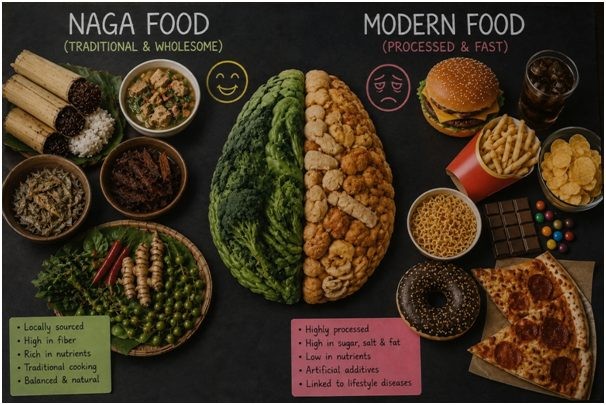
Nagaland, like the rest of the world, is changing rapidly. Along with modernization has come a shift in the way we eat. Cafés, fast-food outlets, K-pop-inspired eateries, Chinese restaurants, and ready-to-eat foods have become increasingly popular, especially among young people. Eating out occasionally is part of modern life and there is nothing wrong with enjoying different cuisines. However, the concern begins when convenience replaces nutrition and highly processed foods become part of our everyday diet rather than an occasional treat.
Busy lifestyles have also changed what many children eat. With parents balancing work, household responsibilities, and childcare, packaged snacks, processed foods, sugary drinks, and instant meals often find their way into school tiffin boxes because they are quick, convenient, and easily available. This is understandable, but over time these daily choices shape children's eating habits and may influence their overall health, including their brain health.
Another challenge is that many of us cannot distinguish between healthy and unhealthy carbohydrates, and this is where the problem often begins. Many people believe that all carbohydrates are unhealthy, but this is far from the truth. In fact, carbohydrates are the brain's primary source of energy. The real difference lies in the type of carbohydrates we choose. Whole grains, millet, brown rice, fruits, vegetables, beans, and legumes provide steady energy together with fibre, vitamins, and minerals. In contrast, sugary drinks, sweets, refined flour products, and many ultra-processed snacks provide excess sugar with little nutritional value. Understanding this simple difference can help families make healthier food choices without unnecessarily fearing carbohydrates.
Researchers have also highlighted what is known as the gut-brain connection. The trillions of beneficial bacteria living in our intestines help produce chemicals that influence mood and emotional well-being 2,3,4. A balanced diet nourishes these beneficial bacteria, while diets high in ultra-processed foods and added sugars may disrupt this balance5,6. Studies have increasingly shown that people who consume more nutritious diets tend to have better mental well-being and a lower risk of depression and anxiety.7,8,9 While this does not mean that unhealthy food directly causes mental illness, it reminds us that the brain, like every other organ in the body, depends on good nutrition to function well.
Many parents, teachers, and caregivers have observed that children and adolescents today seem to find it harder to cope with stress, disappointment, and emotional challenges. There is no single explanation for this. Parenting styles, sleep, physical activity, screen time, academic pressure, social media, genetics, and life experiences all influence emotional regulation. Diet is only one part of this complex picture. However, because it is a modifiable factor, improving nutrition is one practical step that every family can take to support healthier development.
Perhaps the greatest irony is that Nagaland has always been blessed with nutritious traditional foods. Traditional Naga fermented foods, together with fresh locally available foods such as leafy green vegetables, fruits, legumes, and locally reared animal products, provide a rich source of essential nutrients and bioactive compounds. 10,11,12. While these foods have not been directly shown in clinical studies to improve mental health, their nutritional quality and ability to support a healthy gut microbiota suggest they may contribute to brain health and mental well-being as part of an overall balanced diet. As we embrace modernization, we should not lose sight of the value of our own food heritage. Progress should not mean replacing wholesome traditional foods with highly processed alternatives.
Another tradition worth preserving is eating together as a family. Years ago, families gathered around the table, shared stories, laughed, and enjoyed meals together. Today, many meals are eaten in a hurry, in front of a television, or while scrolling through a mobile phone. Family mealtimes are about more than food. They strengthen relationships, encourage conversation, help parents understand what their children are going through, and create a sense of belonging. These everyday moments can contribute to emotional well-being just as much as the nutrients on the plate.
Healthy eating does not require expensive foods or complicated diets. Small, consistent choices often make the greatest difference. Preparing home-cooked meals more often, choosing traditional local foods, including fruits and vegetables in daily meals, limiting sugary drinks and ultra-processed snacks, and teaching children to enjoy balanced meals are simple steps that every family can take.
Mental health is shaped by many factors, and diet is not the only answer. Yet it is one factor that lies within our control. Every meal is an opportunity to nourish not only our body but also our mind. As Nagaland continues to grow and modernize, let us embrace progress without forgetting the wisdom of our traditional foods and family mealtimes. Sometimes, protecting our mental health begins with something as ordinary—and as powerful—as the food on our plate.
REFERENCE
1. 1.Gómez-Pinilla F. Brain foods: the effects of nutrients on brain function. Nat Rev Neurosci. 2008;9(7):568-578. doi:10.1038/nrn2421. [cited 2026 Jul 4]. Available from: https://pubmed.ncbi.nlm.nih.gov/18568016/
2. Cryan JF, O'Riordan KJ, Cowan CSM, Sandhu KV, Bastiaanssen TFS, Boehme M, et al. The microbiota-gut-brain axis. Physiol Rev. 2019;99(4):1877-2013. doi:10.1152/physrev.00018.2018. [cited 2026 Jul 4]. Available from: https://pubmed.ncbi.nlm.nih.gov/31460832/
3. Cryan JF, Dinan TG. Mind-altering microorganisms: the impact of the gut microbiota on brain and behaviour. Nat Rev Neurosci. 2012;13(10):701-712. doi:10.1038/nrn3346. [cited 2026 Jul 4]. Available from: https://pubmed.ncbi.nlm.nih.gov/22968153/
4. Dinan TG, Cryan JF. Gut instincts: microbiota as a key regulator of brain development, ageing and neurodegeneration. J Physiol. 2017;595(2):489-503. doi:10.1113/JP273106. [cited 2026 Jul 4]. Available from: https://pubmed.ncbi.nlm.nih.gov/27718250/
5. Lane MM, Gamage E, Travica N, Dissanayaka T, Ashtree DN, Gauci S, et al. Ultra-processed food consumption and mental health: a systematic review and meta-analysis of observational studies. Nutrients. 2022;14(13):2568. doi:10.3390/nu14132568. [cited 2026 Jul 4]. Available from: https://pubmed.ncbi.nlm.nih.gov/35807749/
6. Knüppel A, Shipley MJ, Llewellyn CH, Brunner EJ. Sugar intake from sweet food and beverages, common mental disorder and depression: prospective findings from the Whitehall II study. Sci Rep. 2017;7:6287. doi:10.1038/s41598-017-05649-7. [cited 2026 Jul 4]. Available from: https://www.nature.com/articles/s41598-017-05649-7
7. Marx W, Moseley G, Berk M, Jacka FN. Nutritional psychiatry: the present state of the evidence. Proc Nutr Soc. 2017;76(4):427-436. doi:10.1017/S0029665117002026. [cited 2026 Jul 4]. Available from: https://pubmed.ncbi.nlm.nih.gov/28942748/
8. Lassale C, Batty GD, Baghdadli A, Jacka F, Sánchez-Villegas A, Kivimäki M, et al. Healthy dietary indices and risk of depressive outcomes: a systematic review and meta-analysis of observational studies. Mol Psychiatry. 2019;24(7):965-986. doi:10.1038/s41380-018-0237-8. [cited 2026 Jul 4]. Available from: https://pmc.ncbi.nlm.nih.gov/articles/PMC6755986/
9. Molendijk M, Molero P, Ortuño Sánchez-Pedreño F, Van der Does W, Martínez-González MA. Diet quality and depression risk: a systematic review and dose-response meta-analysis of prospective studies. J Affect Disord. 2018;226:346-354. doi:10.1016/j.jad.2017.09.022. [cited 2026 Jul 4]. Available from: https://www.sciencedirect.com/science/article/pii/S0165032717307048
10. Deb CR, Jamir B. Ethnic fermented food products of Nagaland, India. J Food Chem Nanotechnol. 2020;6(1):18-27. doi:10.17756/jfcn.2020-079. [cited 2026 Jul 4]. Available from: https://www.researchgate.net/publication/339874495_Ethnic_Fermented_Food_Products_of_Nagaland_India
11. .Jamir B, Deb CR. Some fermented foods and beverages of Nagaland, India. Int J Food Ferment Technol. 2014;4(2):87-92. doi:10.5958/2321-7111.2014.00001.8. [cited 2026 Jul 4]. Available from: https://indianjournals.com/article/ijfft-4-2-002
12. Jamir B, Deb CR. Nutritional and microbiological study of Anishi: a traditional fermented food product of Nagaland, India. J Adv Food Sci Technol. 2017;4(3):113-121. [cited 2026 Jul 4]. Available from: https://ikprress.org/index.php/JAFSAT/article/view/3701

