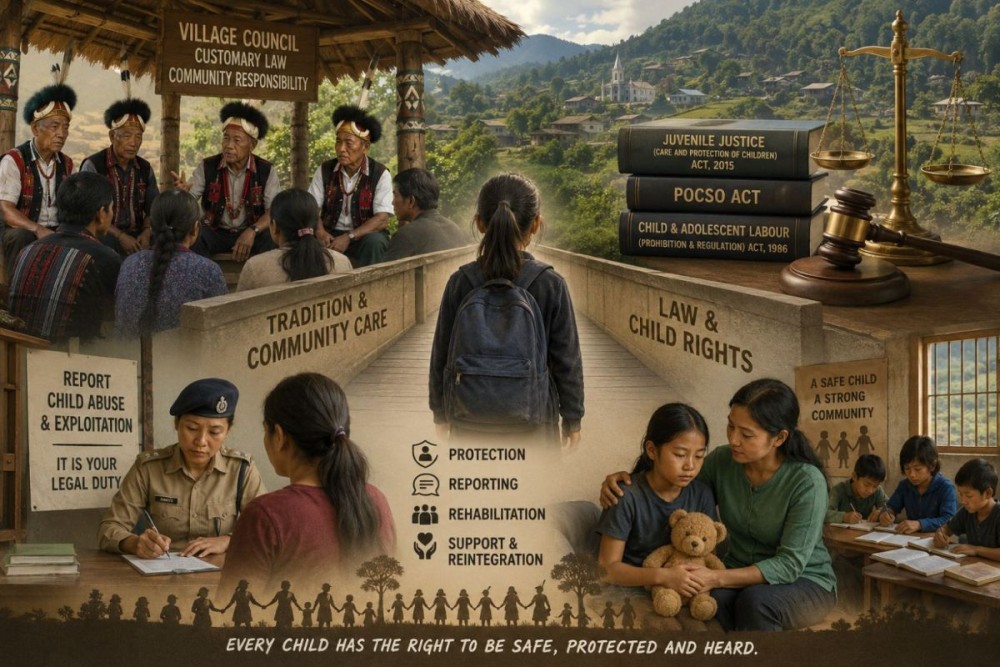
Bridging customary institutions and statutory law to strengthen child protection, reporting, rehabilitation and community support in Nagaland. (AI-generated illustration)
Upholding child safety, mandatory reporting and adequate rehabilitation key challenges
H Anguvi Chishi
Dimapur | August 27
In Nagaland, where village councils and customary laws remain deeply woven into the social and administrative life of communities, protecting children can sometimes mean navigating the delicate space between customary practice and statutory law.
In some cases, matters involving abuse, exploitation and child labour, child-rights workers stated, were dealt with within villages rather than referred to the appropriate authorities, often amid concerns over family honour, community reputation and social stigma.
However, they noted greater understanding of child rights is gradually changing that approach, with communities increasingly recognising that serious matters involving children must be referred to the appropriate authorities.
The shift reflects a broader effort to translate national child-protection laws, particularly the Juvenile Justice (Care and Protection of Children) Act, 2015 and the Protection of Children from Sexual Offences (POCSO) Act, into practice in Nagaland, where customary institutions continue to play an important role.
From silence to reporting
A child-rights activist highlighted that some cases of abuse, exploitation and child labour were previously handled within villages instead reporting to legal authorities.
“Reporting was often delayed due to concerns about the reputation of the family and the image of the village. Consequently, many cases went unreported,” she divulged.
Greater public awareness, however, has encouraged more timely reporting, she added. “Over the years we have witnessed a positive change as public awareness on child safety and protection has increased, encouraging timely reporting of such cases.”
The activist said the change had also required greater engagement with tribal and community institutions.
The combined efforts of child protection services, district administrations and other stakeholders had helped communities understand the importance of following statutory procedures in matters concerning children, she said.
With greater understanding of the consequences of violating children’s rights, communities were also becoming more willing to cooperate with authorities.
Yet social pressures have not disappeared. Families may still seek compromises because of fear of stigma, shame and discrimination, potentially adding another layer of trauma for children who have experienced abuse or exploitation.
Protection does not end with reporting
As reported by The Morung Express on June 24, 2026, Dimapur Commissioner of Police Aotula T Imchen told a Dimapur District Planning and Development Board meeting that POCSO cases in Nagaland had risen from seven in 2022 to 15 in 2025.
She also said 216 missing children were traced in 2025.
The figures underscore the continuing need for effective reporting, investigation and rehabilitation mechanisms, although an increase in reported cases alone does not establish an increase in the actual incidence of abuse.
The law also provides safeguards against disclosure of a child’s identity.
Section 23 of the POCSO Act restricts media reporting or presentation of comments about a child that, without complete and authentic information, could lower the child’s reputation or infringe privacy. It also prohibits disclosure of information that could reveal the child’s identity. Contravention can attract imprisonment of six months to one year, or fine, or both.
Section 74 of the Juvenile Justice Act prohibits publication, in reports concerning an inquiry, investigation or judicial proceeding, of the name, address, school, photograph or other particulars that could identify a child in conflict with law, a child in need of care and protection, or a child victim or witness. Violation can attract imprisonment of up to six months, a fine of up to Rs 2 lakh, or both.
The Child Welfare Committee (CWC) has a statutory role in assessing the care and protection needs of children and ensuring their care, protection, rehabilitation and restoration. Its functions include decisions relating to foster care, institutional placement, sponsorship and other services based on the child’s individual care plan.
Cases involving sexually abused children reported to CWC are designated as ‘children in need of care and protection’ under POCSO, the Committee is also required to take steps for rehabilitation.
Poverty and domestic work
The task becomes more complex when poverty, education and family circumstances influence where a child lives and works.
One major concern raised by the activist is the continuing practice of employing children as domestic helpers.
In some families, domestic workers are engaged for wages or under arrangements in which education is offered in return for their services.
Children in such situations can be particularly vulnerable to physical, emotional and sexual abuse, especially when separated from their families and working in settings where their welfare is difficult to monitor.
Under the Child and Adolescent Labour (Prohibition and Regulation) Act, 1986, employment of children below 14 is generally prohibited, subject to statutory exceptions, while adolescents aged 14 to below 18 cannot be employed in hazardous occupations and processes.
Employing a child in violation of Section 3 can attract imprisonment of six months to two years, or a fine of Rs 20,000 to Rs 50,000, or both. Similar penalties apply to prohibited employment of adolescents under Section 3A.
The issue is particularly significant in domestic work, where children may be in isolated settings and allegations of exploitation or abuse can remain undetected.
Poverty and limited access to education and other basic facilities in some areas continue to influence decisions by parents to send children away for work, despite restrictions and community-level regulations.
“This remains one of the major challenges in addressing child labour and child protection,” the activist noted.
She called for stronger implementation and a collective approach involving the government, stakeholders, tribal bodies and local communities.
According to another activist, every district in Nagaland has a functioning Child Protection Services unit. While challenges vary between districts, the common objective is to ensure care, protection and appropriate services for children.
The activist said the time taken for disposal of cases could vary depending on their nature and complexity and the legal procedures involved.
Where customary responsibility meets statutory law
For village institutions, the challenge increasingly lies in understanding where customary responsibility ends and statutory responsibility begins.
Village councils continue to work with law enforcement agencies and, according to the activist, have increasingly adopted a cooperative approach in referring cases to police.
“They can play the role of a bridge between the community and law enforcement, help prevent conflicts and support the implementation of the rule of law,” the activist said.
A village GB from Chümoukedima district said understanding of child protection had been limited in the past.
“In the past, parents or the village or the community as a whole lacked the idea of child protection, especially in the event of child abuse or labour or exploitation,” the GB said.
Greater knowledge had changed attitudes in many villages, he maintained.
“With the advancement of time and knowledge, villages are opening their eyes and instead handing over the case to the concerned authorities in matters relating to a child,” he added.
The transition, however, is not absolute. The GB stated that village councils could initially address disputes arising within the community according to customary practices, while matters considered serious or beyond their ability to resolve were referred to the administration or police.
Nagaland’s Village and Area Councils Act, 1978, gives Village Councils a role in administering justice within village limits according to customary law and usages and the law in force.
However, in serious cases, it provides that an offender may be arrested but should be handed over to the nearest Administrative Officer or police station without undue delay.
In child-protection matters, however, customary mechanisms must operate alongside statutory requirements and cannot replace mandatory legal procedures.
An advocate who works on child-related cases said village councils could not settle POCSO matters through customary law, saying, “POCSO itself is a criminal law and so it has to go through legal procedures. A village council can hear the concern but it cannot settle a POCSO offence.”
If allegations involving children are brought before a council, it should not attempt a customary settlement but immediately inform the police or CWC and cooperate with the authorities while protecting the child from pressure, the advocate added.
Under Section 19 of POCSO, any person, including a child, who has knowledge that an offence under the Act has been committed or apprehension that it is likely to be committed must provide the information to the Special Juvenile Police Unit or local police.
Failure to report can attract punishment under Section 21.
Where necessary, police or the SJPU must make immediate arrangements for the child’s care and protection, including admission to a shelter home or hospital, and report the matter to the CWC and the Special Court or Court of Session within 24 hours.
The statutory requirement makes the distinction between customary handling and formal legal intervention particularly important in POCSO cases.
Preventing exploitation at village level
Domestic work is another area where village-level institutions could play a stronger preventive role, another GB said.
Village councils, he said, should ensure that households employing domestic workers follow appropriate safeguards against exploitation.
Where abuse or exploitation occurs, councils should take appropriate action and refer cases involving children to the competent legal authorities, he added.
The GB also called for wider awareness and sensitisationprogrammes by the government and NGOs, particularly on the JJ Act and POCSO.
“There is not sufficient awareness regarding how to protect a child’s identity when such a case occurs,” he noted.
Awareness programmes, he added, should go beyond legal provisions, reporting mechanisms and punishment. Communities also need to understand how to provide emotional and psychological support and facilitate rehabilitation so that children are not neglected or permanently defined by their experiences.
“The awareness must also cover how to help give a child the mental and emotional support and rehabilitation within the village to ensure that a child is never neglected or affected by the incident,” he added.
Helping a child heal
A law can establish procedures, a committee can order rehabilitation and police can register a case. But a child’s return to ordinary life often takes place in the same community where the abuse occurred — among neighbours, relatives and people who know the family.
The real test of Nagaland’s child-protection system, therefore, lies not only in whether an offence is reported, but in what follows: whether the child receives protection, support and rehabilitation without stigma.
The broader challenge is to ensure that customary institutions can continue to perform their recognised community and justice functions while statutory child-protection obligations remain fully intact.
The journey from policy to practice remains incomplete. But every time a community chooses a child’s safety over silence, reporting over concealment and support over stigma, Nagaland moves a step closer to making its child-protection laws a lived reality.
Names have been left anonymous either at the individuals’ request or to protect identities.
Disclaimer: This report is part of the ‘Media Fellowship Initiative on Child Protection Awareness and Ethical Public Discourse’ series, supported by DKA Austria and implemented by Prodigals’ Home. The content is intended for public legal literacy and preventive awareness.